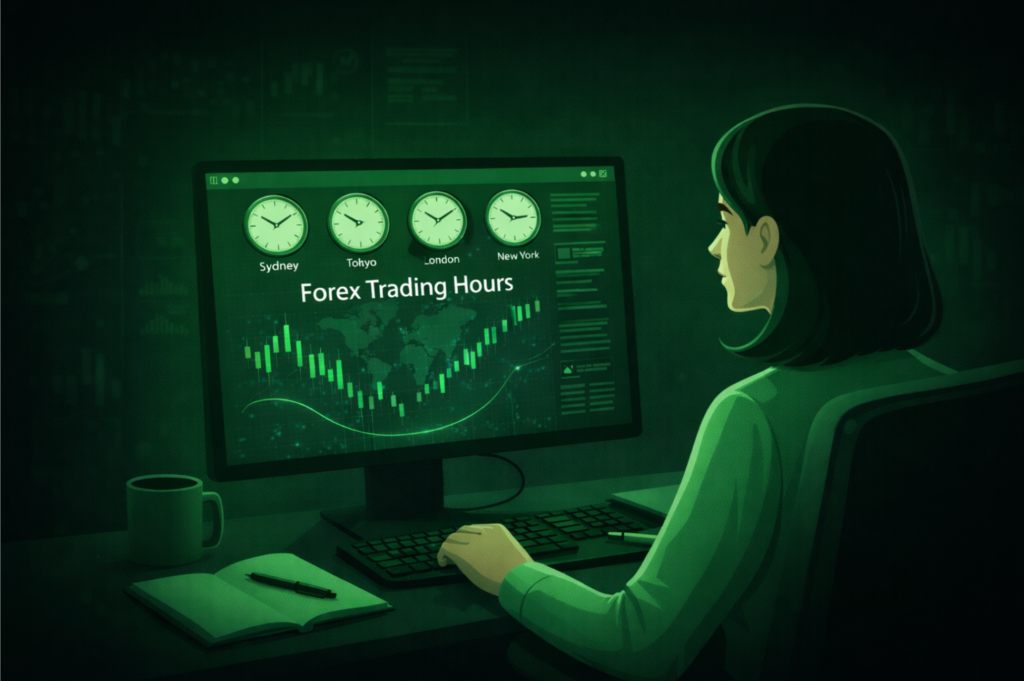
Financial markets operate across multiple time zones. As a result, trading takes place almost continuously throughout the week. While this constant access creates flexibility, it also introduces an important question for traders.
When are the best trading hours?
Not every hour offers the same opportunities. Some periods bring strong liquidity and large price movements. Other periods remain quiet and slow.
Understanding global trading hours helps traders recognize when markets are most active and how these activity patterns influence price behavior.
In this guide, we explore global trading sessions, why they matter, and how traders can use market timing to improve decision making.
What Are Global Trading Hours?
Global trading hours refer to the daily schedule during which financial markets around the world are open.
Different regions operate during their own local business hours. As one market closes, another begins trading. This rotation creates a continuous cycle of market activity.
The forex market is the best example of this global structure. Currency trading takes place twenty-four hours per day from Monday through Friday.
However, trading activity does not remain constant. Volume rises and falls as different financial centers open and close.
This is why traders often divide the day into market sessions.
The Major Market Sessions
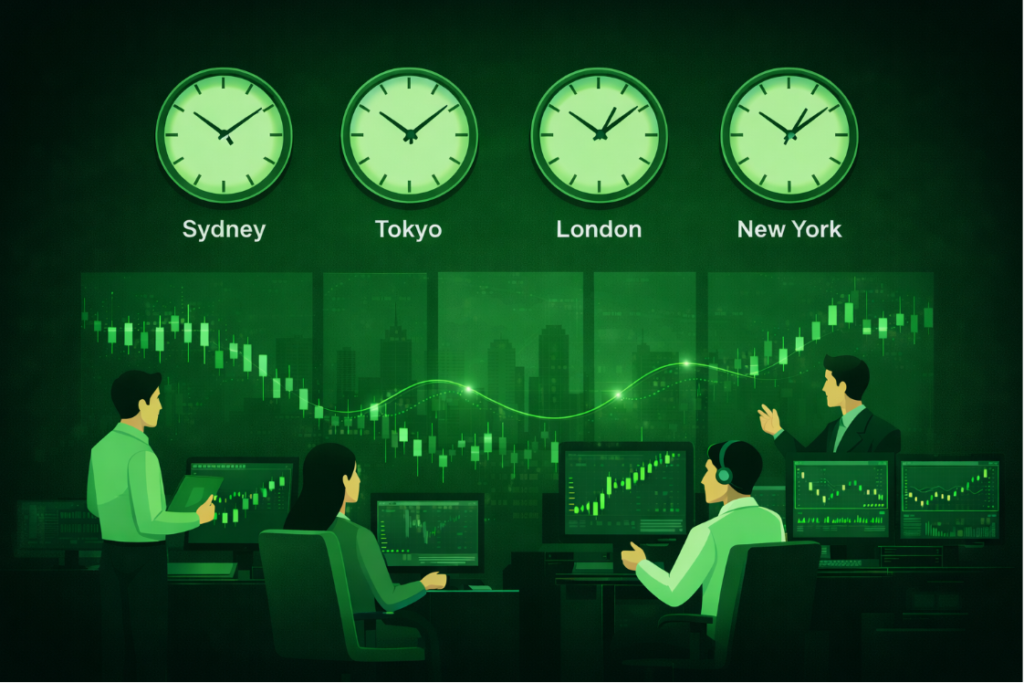
The global trading day can be divided into four primary sessions. Each session reflects activity from a major financial center.
Sydney Session
The Sydney session begins the trading week. It opens shortly after the weekend break and introduces the first liquidity of the new trading cycle.
Although activity begins here, volume tends to remain relatively low. Price movements may appear slower compared to later sessions.
Nevertheless, this session provides the foundation for the upcoming trading day.
Tokyo Session
The Tokyo session represents the Asian trading period. Japan remains one of the largest financial markets in the world.
Currency pairs related to the Japanese yen often show greater activity during this session.
Economic announcements from Asian economies can also influence price behavior during this period.
However, volatility still tends to be lower than during European and American sessions.
London Session
The London session introduces the largest increase in global trading activity.
London has historically been one of the most influential financial centers in the world. A large percentage of global currency transactions occur during this session.
Because of the higher liquidity, price movements become more consistent. Many traders prefer this session because spreads are typically lower and execution tends to be smoother.
New York Session
The New York session represents the American trading period.
During the early hours of this session, it overlaps with London. This overlap produces one of the most active trading periods in the global market.
Economic announcements from the United States frequently occur during this time. Interest rate decisions, inflation reports, and employment data can create strong market reactions.
Once the London session closes, trading activity often begins to slow again.
Why Trading Hours Are Important
Understanding trading hours is essential for several reasons.
Liquidity Levels
Liquidity measures how easily traders can enter and exit positions.
Higher liquidity allows trades to execute quickly and at more stable prices. Lower liquidity can increase spreads and lead to unpredictable price movement.
Market Volatility
Volatility refers to the speed and size of price movements.
Active sessions usually produce higher volatility. This can create opportunities for traders seeking short-term price movements.
However, higher volatility also increases risk.
Market Efficiency
Markets tend to respond more efficiently to information during active trading hours.
When many participants are involved, prices adjust quickly to new economic data or news events.
Strategy Compatibility
Different trading strategies perform better in different market conditions.
Some strategies rely on strong trends, while others depend on stable ranges.
Knowing when markets are most active allows traders to apply strategies at the appropriate time.
The London and New York Overlap
The overlap between the London and New York sessions is often considered the most active trading period of the day.
During this window, traders from Europe and North America participate simultaneously.
Institutional investors, banks, hedge funds, and retail traders all contribute to market volume.
This combination often produces strong price movement and increased trading opportunities.
Many short-term traders focus their activity during this period.
Quiet Trading Periods
While some sessions bring strong activity, other hours are much quieter.
The late afternoon in the United States often represents one of the slowest periods of the trading day.
During these hours, fewer major financial centers are active.
Lower participation can reduce volatility and limit price movement.
Although quieter markets may seem less attractive, some strategies benefit from these conditions.
Institutional Influence on Trading Hours
Large financial institutions play a major role in shaping trading activity.
Banks, investment firms, and hedge funds typically operate during normal business hours in major financial centers.
Their participation increases liquidity and influences price movements.
When multiple institutions operate at the same time, trading volume rises significantly.
This is one reason why session overlaps produce stronger market activity.
Economic News and Market Activity
Economic announcements can also influence trading hours.
Important data releases often occur during the London or New York sessions.
Examples include inflation reports, employment data, and central bank decisions.
These announcements can trigger rapid price movement and increase volatility.
Traders often monitor economic calendars to anticipate these events.
How Traders Use Trading Hours
Experienced traders often build their schedules around specific market sessions.
Instead of watching the market all day, they focus on the periods that best match their strategy.
For example:
Day traders often focus on the London session.
Scalpers may prefer the London and New York overlap.
Swing traders may analyze markets outside active hours but execute trades during stronger liquidity periods.
By aligning their trading activity with market sessions, traders can improve focus and efficiency.
Automation and Trading Hours
Automated trading strategies also benefit from understanding global trading hours.
Many algorithmic systems are designed to operate during specific market conditions.
Some strategies target high-volatility periods, while others focus on stable ranges.
Automated systems can execute trades consistently. However, timing still influences their performance.
Developers often optimize algorithms to run during sessions where historical data shows the best results.
Risk Management and Timing
Trading during active hours can create more opportunities, but it also requires careful risk management.
High volatility can produce both profits and losses.
Traders should consider position sizing, stop losses, and overall exposure when trading during fast market conditions.
Maintaining discipline and following a clear strategy remains essential regardless of trading hours.

Conclusion
Global trading hours play a central role in how financial markets operate. While markets remain open for most of the week, activity shifts between major financial centers.
Understanding these shifts helps traders identify periods of higher liquidity, stronger price movement, and improved trading conditions.
Whether trading manually or using automated systems, timing remains an important factor in market participation.
By studying global trading sessions and adapting strategies accordingly, traders can approach financial markets with greater awareness and structure.
Disclaimer
Trading in financial markets carries risk and may not be suitable for all individuals. Market conditions can change quickly, and losses can occur. The information provided in this article is for educational purposes only and does not constitute financial advice. Traders should perform

Global Trading Hours Explained: When Markets Are Most Active and Why It Matters
Financial markets operate across multiple time zones. As a result, trading takes place almost continuously throughout the week. While this constant access creates flexibility, it

CFDs Trading Explained: How Contracts for Difference Work, Risks Included
Many people enter the markets looking for clarity. They hear about forex, stocks, indices, and commodities, but they are still unsure how trading actually works.

Essential Trading Tools Every Serious Trader Uses (And How to Choose the Right Ones)
A practical overview of how a forex demo account works and what traders should know before getting started.

Trading News That Actually Matters: How to Filter Market Noise From Real Opportunity
Most traders do not lose because they are uninformed. They lose because they are overloaded. Trading news is constant. You can refresh your feed every

Trading Analysis Explained: How Professionals Read Markets Before Placing a Trade
Disclaimer (InvidiaTrade): This article is for educational purposes only and does not provide financial, investment, or trading advice. Trading carries risk, and you may lose

What Makes a Best Trading Platform?
https://www.youtube.com/watch?v=i17trtTkft8 When people search for the best trading platform, they often expect a single answer. In reality, “best” depends on what you trade, how you