



Table of Contents
Contracts for Difference, commonly known as CFDs, have become one of the most popular financial instruments among active traders. If you’ve searched for CFDs meaning trading, you’re probably looking for a simple explanation of what CFDs are, how they work, and why traders use them.
CFDs allow traders to speculate on market price movements without purchasing the underlying asset. Instead of owning stocks, commodities, or currencies directly, traders enter into an agreement based on the change in price between the opening and closing of a position.
This guide explains the fundamentals of CFD trading, the opportunities it offers, the risks involved, and the key concepts every trader should understand.
What Are CFDs?
A Contract for Difference is an agreement between a trader and a broker to exchange the difference in an asset’s price from the moment a position is opened until it is closed.
The trader does not own the underlying asset.
Instead, they speculate on whether the market will move higher or lower.
How CFD Trading Works
CFD trading focuses entirely on price movement.
If a trader expects the price to increase, they open a buy position.
If they expect the price to fall, they open a sell position.
The profit or loss depends on how far the market moves between the opening and closing prices.
Markets Available Through CFDs
CFD brokers often provide access to multiple asset classes, including:
- Stocks
- Forex
- Commodities
- Indices
- ETFs
- Cryptocurrencies
Having multiple markets available through one platform gives traders greater flexibility.
Why Traders Choose CFDs
Many traders choose CFDs because they offer:
- Access to global markets
- Long and short trading opportunities
- Flexible position sizes
- Advanced trading platforms
- Mobile access
- Risk management features
However, CFDs also involve substantial risk and require careful planning.
Understanding Leverage
Leverage allows traders to control larger market positions with a smaller initial investment.
Although leverage can magnify gains, it can also magnify losses.
This makes proper risk management essential.
Margin Explained
Margin is the amount required to open a leveraged CFD position.
It is only a portion of the total position value.
If market prices move against the trader, additional funds may be required to maintain the position.
Long and Short Positions
One advantage of CFD trading is the ability to trade in both market directions.
A buy position aims to benefit from rising prices.
A sell position aims to benefit from falling prices.
This flexibility attracts many active traders.
Trading Platforms
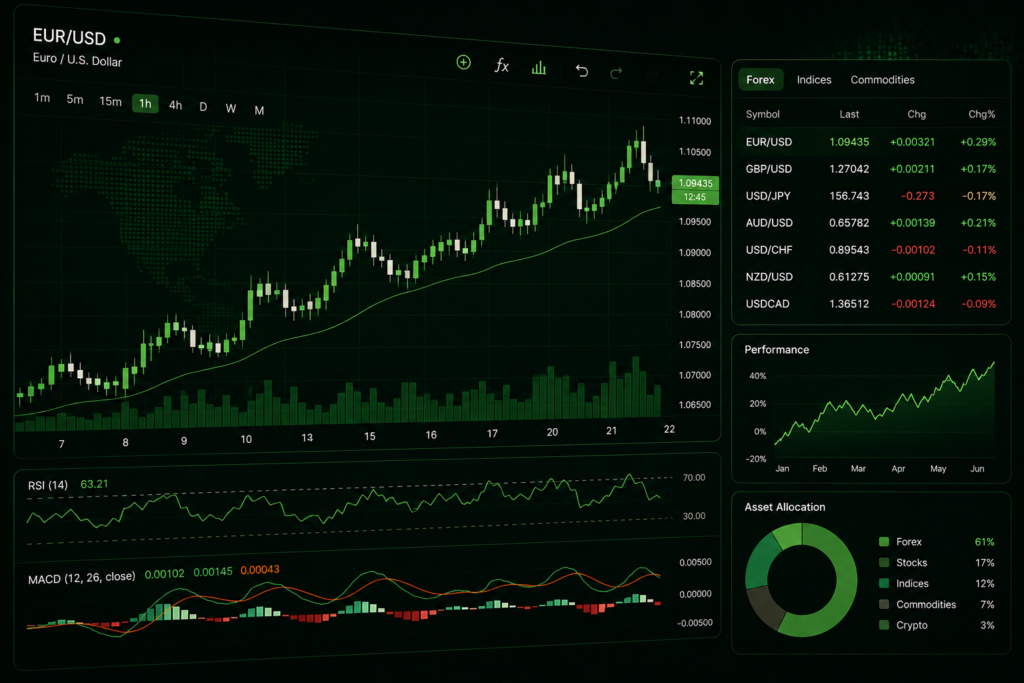
Modern CFD platforms typically include:
- Live charts
- Technical indicators
- Market news
- Watchlists
- Order management
- Mobile applications
These tools help traders monitor financial markets more effectively.
Benefits of CFD Trading
Potential benefits include:
- Market flexibility
- Multi-asset access
- Advanced analysis tools
- Ability to trade falling markets
- Real-time pricing
- Portfolio diversification opportunities
These advantages do not remove trading risk.
Risks Every Trader Should Understand
CFD trading involves important risks, including:
- Market volatility
- Leverage
- Margin calls
- Overnight financing
- Emotional trading
- Unexpected economic events
Risk management should always remain a priority.
Managing Risk
Many successful traders use structured risk management techniques.
These include:
- Stop-loss orders
- Take-profit orders
- Position sizing
- Diversification
- Trading plans
Managing losses is often considered just as important as finding profitable opportunities.
Technical Analysis
Technical analysis focuses on price charts.
Common indicators include:
- RSI
- MACD
- Moving averages
- Bollinger Bands
- Support and resistance
These tools help traders evaluate price behavior.
Fundamental Analysis
Fundamental analysis examines factors that influence financial markets.
Examples include:
- Economic reports
- Inflation
- Interest rates
- Employment data
- Company earnings
- Central bank announcements
Many traders combine both technical and fundamental analysis.
Common Beginner Mistakes
New CFD traders often:
- Use excessive leverage
- Trade without a plan
- Ignore stop-loss orders
- Risk too much capital
- React emotionally
Education and practice can help reduce these mistakes.
Demo Trading
Many brokers provide demo accounts.
These allow traders to:
- Practice strategies
- Learn platform features
- Test indicators
- Understand order placement
Demo trading can help build confidence before trading live markets.
Technology and AI
Modern CFD platforms increasingly use:
- AI-assisted analysis
- Automated alerts
- Market scanners
- Performance tracking
- Mobile monitoring
Technology can improve efficiency but should never replace independent judgment.
Is CFD Trading Right for Everyone?
CFDs may suit traders who understand financial markets and accept the risks involved.
However, they may not be appropriate for everyone.
Before trading CFDs, individuals should fully understand leverage, margin, and the possibility of losing capital.
Education should always come before live trading.
Final Thoughts
Understanding C
FDs meaning trading helps traders make more informed decisions about one of today’s most widely used financial products.
CFDs offer flexibility, market access, and advanced trading opportunities without requiring ownership of the underlying asset.
However, they also involve substantial risk, particularly when leverage is involved.
By focusing on education, risk management, and disciplined decision-making, traders can better understand how CFDs fit into the broader financial markets.
Disclaimer
CFDs are complex financial instruments and carry a high risk of losing money rapidly because of leverage. Trading CFDs may not be suitable for every investor. This article is for educational and informational purposes only and should not be considered financial, investment, legal, or tax advice. Always conduct your own research and consult a qualified financial professional before making trading decisions.

AUD Explained: Australian Dollar Strength, Interest Rates, and Forex Market Trends
Table of Contents The Australian dollar has been one of the currencies attracting attention in the forex market during 2026. A combination of Australian monetary

Define Foreign Exchange Management: Meaning, Strategies, and Currency Risk Explained
Table of Contents To define foreign exchange management, think of it as a system for dealing with the uncertainty created when the value of

Top Earning Traders: How the World’s Most Successful Traders Built Their Edge
Table of Contents The world’s top earning traders have generated fortunes from some of the most competitive markets on the planet. Some traded currencies.

AI to Buy and Sell Crypto: A Complete Guide to Automated Crypto Trading
Table of Contents Crypto markets move quickly, operate continuously, and produce enormous amounts of data. Because of this, many traders are now looking at AI

Quantitative Trading Explained: How Data, Algorithms, and Systematic Strategies Work
Table of Contents Quantitative trading is one of the most important developments in modern financial markets. Banks, hedge funds, proprietary trading firms, and independent

London Session Forex Time: Why the London Session Is the Most Important Period in Forex Trading
Table of Contents The forex market is open 24 hours a day during the trading week, allowing traders around the world to participate at