Table of Contents
Introduction
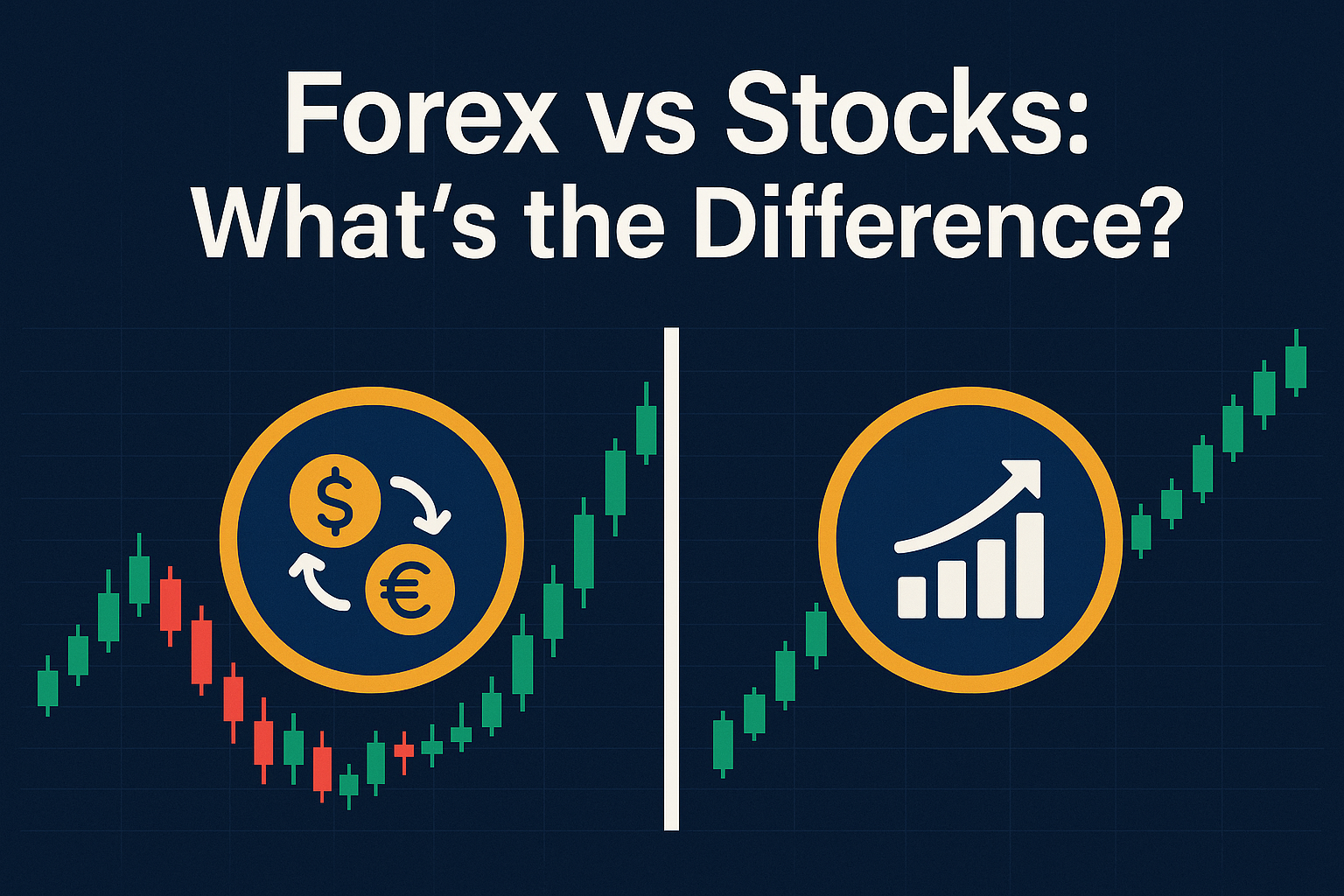
Every trader eventually faces the question: should I focus on forex or stocks? Both markets are popular, both can be profitable, and both attract millions of traders worldwide. Yet the two are built on completely different foundations. Stocks represent ownership in a company. Forex is the constant exchange of currencies in a global marketplace.
At InvidiaTrade, we specialize in forex because it provides unique opportunities for funded traders. With instant funding programs, flexible education, and a focus on risk management, forex is often the better choice for traders who want to grow quickly without investing massive amounts of personal capital.
In this article, we’ll break down the differences between forex and stocks in detail. You’ll learn how each market operates, what drives prices, and which suits different types of traders. We’ll also explain why forex is often better aligned with prop trading and how InvidiaTrade can help you start with education and funding today.
1. What Is Forex?
Forex, short for foreign exchange, is the process of trading currencies against each other. It is the largest financial market in the world, with more than $7.5 trillion traded daily. Unlike stocks, which trade on centralized exchanges, forex is decentralized. Transactions occur electronically across banks, brokers, and institutions.
Traders always deal with currency pairs:
- EUR/USD (Euro vs. US Dollar)
- GBP/JPY (British Pound vs. Japanese Yen)
- USD/CHF (US Dollar vs. Swiss Franc)
If you expect the euro to rise against the dollar, you buy EUR/USD. If you expect it to fall, you sell.
Key features of forex include:
- It’s open 24 hours a day, five days a week.
- It offers high leverage, which means traders can control larger positions with smaller capital.
- It is extremely liquid, especially in major currency pairs.
For prop traders using instant funding, these features are highly attractive. Liquidity and leverage allow traders to make meaningful profits even with modest accounts.
2. What Is Stock Trading?
Stocks represent partial ownership in a company. When you buy a share of Tesla, you own a piece of Tesla. Stocks trade on centralized exchanges such as the New York Stock Exchange or Nasdaq.
The stock market operates under set hours, typically 9:30 am to 4 pm EST for US exchanges. While after-hours trading exists, liquidity is lower and spreads are wider.
Reasons traders and investors like stocks include:
- Dividends: Some companies pay shareholders a portion of their profits.
- Capital appreciation: As a company grows, its stock price often rises.
- Stability: Blue-chip companies are often considered safer long-term investments.
Stocks are heavily influenced by company performance, earnings reports, and industry trends. While this can create opportunities, it also means stock trading often requires deeper research into business fundamentals.
3. Comparing Market Size and Liquidity
The forex market is enormous compared to stocks. With daily turnover exceeding $7.5 trillion, it dwarfs the global stock market’s daily volume of around $200 billion.
Liquidity is critical for traders. In forex, especially with pairs like EUR/USD, orders are executed almost instantly. Spreads are tiny, often just a fraction of a cent. Stocks can also be liquid, particularly for large companies like Apple or Microsoft, but smaller companies often have limited trading volume.
For funded traders, liquidity matters. It means the ability to scale positions without significant slippage, an advantage forex holds over stocks.
4. Trading Hours
One of the biggest appeals of forex is its accessibility. The market is open 24 hours a day, five days a week, moving through global sessions in Asia, Europe, and North America. Traders can find opportunities at any time, day or night.
Stocks, however, are tied to exchange hours. The NYSE and Nasdaq are open for about six and a half hours each trading day. Outside of those hours, opportunities are limited. This can be frustrating for traders in different time zones or those balancing other commitments.
Funded traders appreciate forex because it allows them to adapt trading to their lifestyle, not the other way around.
5. Leverage and Capital Requirements
Forex trading is known for high leverage. Depending on regulations and broker policies, leverage can range from 1:30 to 1:500. A trader with $1,000 could potentially control a $30,000 or even $50,000 position.
This makes forex accessible for those without large starting balances. Combined with instant funding, it means traders can manage meaningful positions without risking their own capital.
Stocks, on the other hand, provide limited leverage. In the United States, margin accounts typically allow 1:2 leverage for long trades and 1:4 for day trading. This means more capital is required upfront, making stock trading less accessible for many aspiring traders.
6. Factors That Drive Each Market
Forex prices move based on macroeconomic and geopolitical events:
- Central bank interest rate changes.
- Inflation and employment data.
- Geopolitical tensions or agreements.
- Trade balances between nations.
Stocks are more company-focused:
- Earnings reports.
- Corporate leadership changes.
- Industry trends.
- Consumer sentiment.
Both markets react to broader economic conditions, but forex responds more directly to global news, while stocks are tied closely to company performance.
7. Advantages of Forex for Funded Traders
- Liquidity: Ideal for scaling trades.
- 24-hour market: Flexibility to trade at any time.
- Leverage: Trade larger positions with smaller accounts.
- Low barriers to entry: Combined with funding, capital is no longer a limitation.
- Volatility: Daily news creates regular opportunities.
For InvidiaTrade-funded traders, these benefits are crucial. Instant funding programs allow traders to skip years of saving and jump straight into trading with real capital.

8. Advantages of Stock Trading
While forex may be better for prop traders, stocks still offer advantages:
- Ownership: You own part of a company.
- Dividends: Passive income opportunities.
- Transparency: Regular reports provide insight.
- Long-term growth: Stocks are a common tool for retirement planning.
For long-term investors, stocks are often seen as safer and more stable.
9. Challenges of Forex Trading
- High volatility: Fast movements can lead to big losses.
- Leverage risk: Easy to overexpose yourself.
- Emotional discipline: Requires strict risk management.
- Complexity: Must understand global events and economics.
10. Challenges of Stock Trading
- Capital intensive: Harder to trade with small accounts.
- Limited hours: Less flexibility than forex.
- Overnight risk: Stocks can gap up or down before the market opens.
- Company collapse: Even respected firms can fail.
11. Case Study: Funded Forex vs. Self-Funded Stocks
Imagine two traders starting at the same time.
Trader A (Forex with InvidiaTrade Funding): Gains access to a $50,000 funded account instantly. Trades EUR/USD with discipline, risking only 1 percent per trade. With daily opportunities, they can aim for 5–10 percent monthly growth, all without risking their personal savings.
Trader B (Stocks with Personal Capital): Invests $10,000 of their own money into a basket of stocks. Their annual growth is around 7–10 percent if the market performs well. Dividends add a little extra income, but growth is slow.
Both traders can succeed, but funded forex provides immediate scalability and lower personal risk.
12. Why Prop Firms Focus on Forex
Most prop firms, including InvidiaTrade, choose forex for funding programs because it offers:
- Consistent liquidity.
- High scalability.
- Leverage-friendly structures.
- Flexible trading hours.
Stocks, while valuable for long-term investors, don’t align as well with the fast-paced, scalable model that prop traders demand.
13. How InvidiaTrade Supports Traders
At InvidiaTrade, we make forex trading accessible in three ways:
- Instant Funding: Skip the traditional evaluation process and start trading with real capital immediately.
- Education: Our resources help you learn forex step by step, from basics to advanced strategies.
- Risk Management: Guidance and structure to ensure traders protect their accounts while seeking profits.
This combination gives traders a clear advantage over going it alone. Instead of spending years building a large stock portfolio, funded forex traders can start trading meaningfully from day one.
14. FAQs
Q1: Why don’t more prop firms offer stocks?
Stocks lack the same liquidity and leverage as forex, making them harder to scale for funding programs.
Q2: Is forex too risky for beginners?
It can be, but with education and strict risk management, traders can minimize risks.
Q3: Can I switch from stocks to forex easily?
Yes. Many traders transition because forex requires less capital and offers more flexibility.
Q4: How does instant funding help traders?
It removes the capital barrier. Traders can focus on strategy rather than worrying about account size.
Q5: Do I need prior experience for InvidiaTrade funding?
Experience helps, but our education programs are designed to prepare you for trading responsibly.
Q6: What is the biggest advantage of forex over stocks for funded accounts?
Liquidity and scalability. You can grow faster without the restrictions that stocks impose.
Q7: Can I trade both forex and stocks at the same time?
Yes, though most funded traders focus on forex. Some investors diversify by holding stocks long-term while trading forex actively.
Conclusion
Both forex and stocks are valuable markets. Stocks provide stability, ownership, and long-term growth, while forex delivers flexibility, leverage, and liquidity. For individual investors with significant capital, stocks remain attractive. But for traders seeking instant funding, scalability, and global opportunities, forex is often the superior choice.
At InvidiaTrade, we are dedicated to helping traders succeed in forex. With instant funding programs, educational support, and risk management systems, we give traders the tools to grow faster without putting their own money at risk.
If you’re ready to step into trading with the backing of a trusted partner, start your journey today at InvidiaTrade.com.

Essential Trading Tools Every Serious Trader Uses (And How to Choose the Right Ones)
A practical overview of how a forex demo account works and what traders should know before getting started.

Trading News That Actually Matters: How to Filter Market Noise From Real Opportunity
Table of Contents START A DEMO ACCOUNT WITH INVIDIATRADE HERE Most traders do not lose because they are uninformed. They lose because they are overloaded.

Trading Analysis Explained: How Professionals Read Markets Before Placing a Trade
Table of Contents START A DEMO ACCOUNT WITH INVIDIATRADE HERE Disclaimer (InvidiaTrade): This article is for educational purposes only and does not provide financial, investment,

What Makes a Best Trading Platform?
Table of Contents START A DEMO ACCOUNT WITH INVIDIATRADE HERE When people search for the best trading platform, they often expect a single answer. In

Day Trading: What It Is, How It Works, and the Risks You Must Know
Table of Contents Day trading gets a lot of attention because it looks exciting. Trades happen quickly, charts move fast, and results show up in

Trading Sites: What They Are, How They Work, and How to Pick One You Can Trust
Table of Contents START A DEMO ACCOUNT WITH INVIDIATRADE HERE Trading sites have become the main gateway to the markets. Years ago, trading felt like