



pullback

Keyword focus: Pullback Retracement counter move within a trend, retracement strategy, Fibonacci retracement Forex, pullback vs reversal

The most successful Forex traders do not chase every candle. They wait for price to come to them. They understand that the clearest path to high probability trades often lies inside the trend itself, not at its extremes. That edge is called the pullback or retracement.

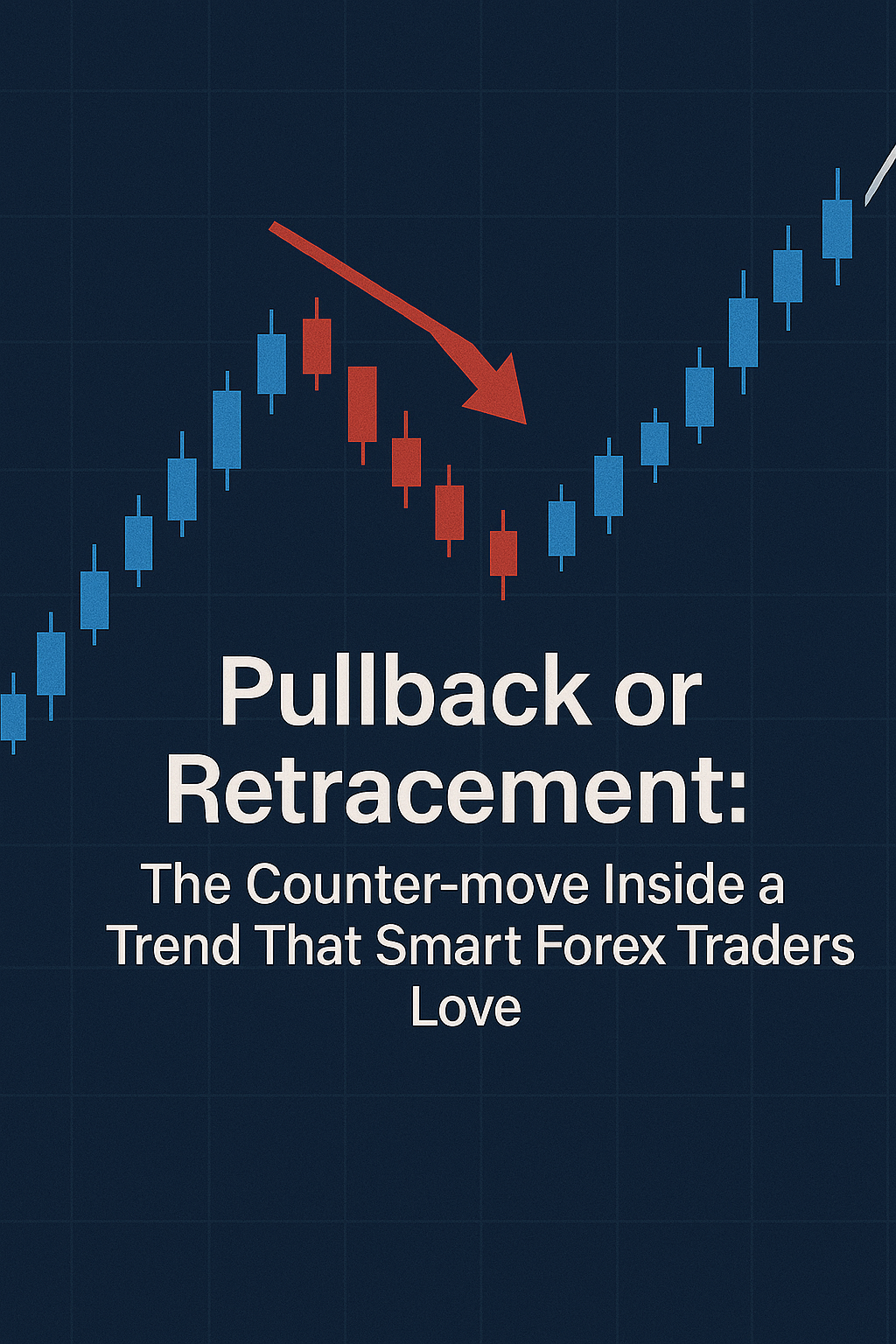
A pullback or retracement is the counter-move within a trend that allows traders to enter with strong conviction and a defined risk profile. It is one of the most trusted, documented, and backtest-friendly strategies in the Forex playbook.

This InvidiaTrade guide breaks down everything you need to know to use pullbacks effectively, including:

  • The core definition of a pullback and how it fits within a trend
  • The difference between retracements and reversals
  • How to spot and validate pullbacks using price action and indicators
  • How Fibonacci retracements can anchor your trade planning
  • Practical entry, stop loss, take profit, and trade management tactics
  • How to integrate pullbacks into a larger trading framework
  • Common errors to avoid
  • Example setups and backtesting steps
pullback

Pullback or Retracement: The Simple Definition

A pullback or retracement is a temporary move against the current trend. The larger trend remains intact. The move is corrective, not impulsive. It often resets indicators, sweeps liquidity, and prepares the next leg of the trend.

  • In an uptrend, a pullback is a dip
  • In a downtrend, a pullback is a rally

Your job as a trader is to identify that the trend is still valid, then buy the dip or sell the rally with defined risk.

Retracement vs Reversal: The Crucial Distinction

Retracement

  • Temporary counter-trend move
  • Trend structure remains intact
  • Price respects key support or resistance levels
  • Usually ends around known technical zones

Reversal

  • Full trend change
  • Key highs or lows are broken and retested
  • Momentum shifts decisively
  • Indicator structure confirms the new bias

Always anchor your analysis in market structure. If the sequence of highs and lows remains intact, you are likely trading a pullback. If that sequence breaks, you may be facing a reversal.

Why Pullback Trading Works for Retail and Institutional Traders

  • Better entries and improved RR compared to late chasing
  • Reproducible with rules, ideal for building long term strategies
  • Aligned with how liquidity cycles work in real markets
  • Less emotional decision making because price comes to you
  • Supports manual and automated execution

Tools To Build a Pullback Framework

1. Market Structure Analysis

Identify whether the trend is bullish or bearish based on higher highs or lower lows. If structure is intact, pullback entries are valid.

2. Fibonacci Retracement Levels

The most popular institutional levels are:

  • 38.2 percent
  • 50 percent
  • 61.8 percent

These are used to estimate where the pullback is likely to end. Combine with price action for confirmation.

3. Moving Averages

  • 20 EMA and 50 EMA for shorter term pullback zones
  • 100 SMA or 200 SMA for deeper pullbacks in swing trading

4. Oscillators

  • RSI: Watch for mid-level resets near 40 to 50 in uptrends and 50 to 60 in downtrends
  • Stochastic: Useful for timing entries at the end of a pullback

5. ATR Volatility

Average True Range helps set stop distances and validates whether the pullback is calm or increasingly aggressive.

6. Candlestick Confirmation

Pin bars, engulfing bars, and inside bars at key retracement zones provide high quality triggers.

pullback

A Step-by-Step Pullback Trade Plan

Step 1: Identify trend on a higher timeframe

Example: Use Daily to define trend, 4H to execute.

Step 2: Mark your key pullback zones

Fibonacci levels, moving averages, horizontal support and resistance.

Step 3: Let price pull back into your defined zone

No entries until this happens. Patience is critical.

Step 4: Confirm with price action and indicators

Look for bullish or bearish rejection candles, momentum turning with RSI or MACD, or even a break of a pullback trendline.

Step 5: Execute with predefined risk

Stops are typically set beyond the most recent swing or the invalidation level for the trend.

Step 6: Manage the trade

  • First target is often the prior swing high or low
  • Secondary targets can be measured moves or extensions
  • Use a trailing stop or scale out as the trend extends

Example: Bearish Pullback on GBP USD

  • Trend context: Lower highs and lower lows on the 4H chart
  • Pullback develops into the 50 percent Fibonacci zone and 50 EMA
  • RSI returns to 55 then turns down
  • A bearish engulfing candle confirms the rejection
  • Short entry with stop above the pullback high and target at prior swing low
  • Risk to reward: 1 to 2.5

How Pullbacks Fit Into a Broader Strategy

Pullbacks do not need to be your only edge. They can be combined with:

  • Breakout strategies to enter initial trends, then pullbacks for continuation
  • Reversal strategies to identify when the pullback fails and a new trend begins
  • Scaling frameworks that add positions only after valid pullbacks
  • Portfolio diversification across pairs and timeframes

Risk Management Rules To Protect Your Account

  • Risk 1 percent or less per trade when you are new
  • Place stops beyond invalidation points, not at arbitrary pip counts
  • Avoid adding to losing pullback trades unless it is a proven, tested plan
  • Beware of macro news events that invalidate otherwise perfect pullbacks
  • Journal every trade to learn which confluences matter most

Common Pullback Trading Errors

  • Jumping in too early without confirmation
  • Entering counter-trend because it looks like a discount
  • Ignoring liquidity sweeps or false breakouts at the end of a pullback
  • Trading every single pullback without context
  • Not aligning with the higher timeframe structure

Backtesting and Forward Testing

  • Collect sample sizes of at least 50 trades per pair and timeframe
  • Track win rate, average win, average loss, risk to reward, and drawdown
  • Test different confirmation rules and time filters
  • Forward test on demo before going live
  • Repeat testing after changing any variable

Which Markets Are Best for Pullback Trading

  • Major pairs such as EUR USD and USD JPY for predictable structure
  • Gold XAU USD for Fibonacci heavy strategies
  • Indices if you trade CFDs with proper risk control

Crypto for high volatility but only if you adapt stop sizing

pullback

Final Thoughts: Trade With the Trend, Let the Market Come to You

Pullbacks or retracements are the simplest and most sustainable way to trade trends with discipline. They align with how institutions position, how liquidity unfolds, and how traders can systematically reduce risk. At InvidiaTrade, we help you turn this logic into a clear, backtested, repeatable approach that you can scale over time.

Stop chasing the market. Start planning intelligent entries inside existing trends.

Disclaimer

Trading foreign exchange on margin carries a high level of risk and may not be suitable for all investors. The information provided is for educational purposes only and does not constitute financial advice. Past performance is not indicative of future results. Always do your own research or consult a licensed financial advisor before making trading decisions.