Preloader
light-dark-switchbtn
brokerage and trading

Table of Contents

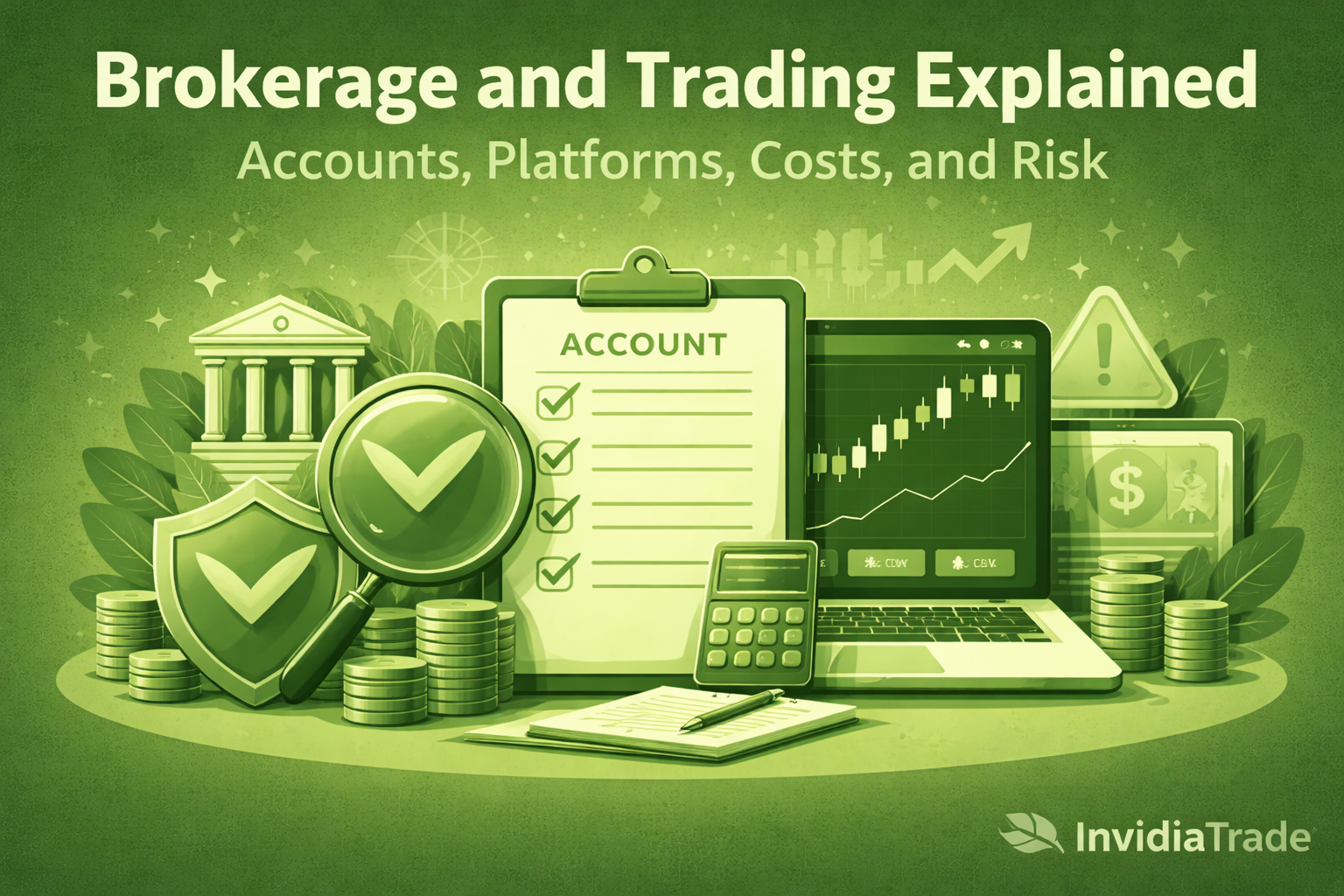
Brokerage and Trading Explained: Accounts, Platforms, Costs, and Risk

Brokerage and trading is the foundation of modern participation in financial markets. However, many traders start by focusing on signals and indicators while overlooking the mechanics that decide whether a good idea becomes a good fill.

This article breaks down brokerage and trading in clear, practical terms. You will learn what a broker does, how a trading account works, what you actually pay to place trades, and how to evaluate the tools and conditions that matter most.

brokerage and trading

What “Brokerage and Trading” Means in Practice

At a high level:

  • Brokerage is the service that enables you to access markets through an account, pricing, and execution.
  • Trading is the act of taking positions in instruments such as forex, indices, commodities, stocks, or CFDs, based on a plan and risk limits.

The difference matters because you can have a strong trading plan but poor brokerage conditions, which can erode performance through costs and execution friction.

How Broker Accounts Work

A broker account is essentially an operational container with defined rules. Those rules shape your trading outcomes.

Key account components include:

Account Base Currency

Your account currency affects:

  • How profit and loss is converted
  • Margin calculations
  • Deposit and withdrawal conversion costs (where applicable)

Leverage and Margin

Leverage allows you to control a larger position with a smaller amount of capital. It also increases sensitivity to price movement.

Important terms:

  • Margin requirement: how much equity is reserved to hold a position
  • Margin level: a health metric based on equity vs used margin
  • Stop-out level: where positions may be closed to prevent negative balance (broker rules vary)

Minimum Trade Size and Contract Specifications

Every symbol has a specification set:

  • Contract size
  • Tick size and tick value
  • Minimum lot and lot step
  • Trading hours and session breaks

Understanding specifications prevents surprises, especially during volatile periods.

Trading Platforms: What They Really Do

A platform is not only a charting tool. It is the interface that creates and transmits orders and then records how they were executed.

A modern trading platform typically provides:

  • Real-time price quotes
  • Order entry and management
  • Position and margin monitoring
  • Charting and indicators
  • Account history and reporting
  • Alerts and risk controls (depending on platform)

When comparing platforms, look beyond features and focus on reliability, order handling, and clarity of reporting.

Order Types Every Trader Should Understand

Brokerage and trading becomes significantly safer when you use the right order type for the right situation.

Market Order

Executes immediately at the best available price.
Best for: entries where speed matters more than precision.
Risk: slippage in fast markets.

Limit Order

Executes at your price or better.
Best for: entering at predefined levels with price control.
Risk: you may not get filled.

Stop Order

Triggers a market order once price reaches a level.
Best for: breakout entries or protective stops.
Risk: stop orders can fill with slippage during fast moves.

Stop-Loss and Take-Profit

Core risk tools that define exit logic.

Practical note: Some market conditions can cause gaps, and stops may fill at the next available price. That is not a malfunction; it is market reality interacting with order rules.

The Real Costs of Brokerage and Trading

To trade intelligently, you need a complete view of costs. Many traders only consider spreads, then wonder why performance differs from expectations.

Common cost components include:

Spread

The bid-ask difference. Spreads can be:

  • Fixed (less common in many markets)
  • Variable (more common, changes with volatility and liquidity)

Commission

Some account types charge commission per lot, per side, or round turn.

Financing / Swap

For leveraged products, holding a position overnight can result in a financing charge or credit, depending on rates and instrument structure. Triple swap days can also apply.

Slippage

Slippage is the difference between expected price and actual fill price. It can be:

  • Negative (worse fill)
  • Positive (better fill)

Slippage is not always “bad,” but it is always real. It must be accounted for.

Non-Trading Costs

Depending on the broker and payment methods, there can be:

  • Deposit/withdrawal fees
  • Currency conversion costs
  • Inactivity fees
  • Data fees (in certain markets)

The right approach is to evaluate total cost under your expected trading behavior, not only headline conditions.

Execution Quality: The Hidden Variable

Execution quality is often the difference between theoretical performance and live results.

Key factors include:

Liquidity Conditions

Liquidity varies by:

  • Time of day
  • Market session overlap
  • News events
  • Risk sentiment shifts

Lower liquidity can mean wider spreads and more slippage.

Latency

Latency is the time between your order submission and the broker server receiving it. It can be influenced by:

  • Your internet quality
  • Your distance to the broker server
  • Platform performance
  • VPS location (if used)

Price Feed and Quote Stability

A price feed can differ across brokers due to liquidity sources and aggregation methods. What matters is consistency and transparency in your trade reports.

brokerage and trading

Risk Management: The Skill That Keeps You Solvent

A broker provides tools, but risk management is your responsibility.

Define Risk Per Trade

A practical approach is to define a percentage of equity at risk per trade. Many traders use conservative ranges. The point is consistency and survival.

Use Multiple Guardrails

Relying on one metric is risky. Consider a small set of controls, such as:

  • Maximum daily loss limit
  • Maximum open exposure
  • Maximum correlated exposure
  • Maximum drawdown threshold that triggers de-risking

Avoid “Margin Creep”

Margin creep happens when a trader gradually increases exposure until one move triggers forced reductions. Monitor used margin and margin level, not only open profit.

Choosing a Broker: A Structured Decision Process

Broker selection should be methodical. A clean process reduces avoidable mistakes.

Step 1: Confirm the Legal and Operational Structure

  • Identify the legal entity behind the brand
  • Understand the jurisdiction governing your account
  • Review client money handling and withdrawal procedures

Step 2: Match Account Conditions to Your Trading Style

Different styles need different conditions:

  • Short-term trading often needs stable spreads and fast execution
  • Longer-term trading may prioritize swap structure and overnight stability
  • Systematic trading often prioritizes consistency and reporting clarity

Step 3: Test, Measure, and Document

Before scaling:

  • Trade small size
  • Record spread behavior by session
  • Track slippage distribution
  • Evaluate support responsiveness and accuracy

Step 4: Scale Gradually

Scaling is a risk event. Increase size only after your process proves stable across different market conditions.

Trading Psychology Meets Brokerage Reality

Many traders blame psychology for poor performance. Psychology matters, but brokerage conditions can also create pressure:

  • Unexpected spread widening can trigger stops
  • Slippage can turn a planned outcome into a surprise
  • Platform interruptions can cause uncertainty

A disciplined trader responds by improving process:

  • Wider, volatility-aware stops (when appropriate)
  • Lower leverage
  • Better session selection
  • Reduced exposure during known volatility windows

In short, you manage what you can control.

Beginner Mistakes That Create Expensive Lessons

Overtrading

More trades do not equal more profits. Often, it simply increases costs.

Trading Without a Risk Plan

If you cannot answer “What is my maximum acceptable loss today?” you are not managing risk.

Confusing Leverage With Skill

Leverage magnifies outcomes. It does not improve decision-making.

Ignoring Market Regimes

A strategy that performs in trending markets may struggle in ranges, and vice versa. Your risk plan should assume conditions will change.

A Simple Trading Plan Template You Can Actually Follow

If you want a practical starting point, use a plan structure like this:

  1. Market and instrument: What you trade and why
  2. Setup: What must be true before you enter
  3. Entry rule: How you execute the entry
  4. Exit rules: Stop-loss, take-profit, and invalidation criteria
  5. Position sizing: How much you trade relative to equity
  6. Risk limits: Daily loss, weekly loss, max drawdown
  7. Review process: How you measure performance and refine

A simple plan executed consistently usually beats a complex plan executed inconsistently.

Final Thoughts: Better Brokerage Decisions Improve Trading Outcomes

Brokerage and trading is not only about picking a market and pressing buttons. It is a full stack: account structure, costs, execution, platform reliability, and risk controls. When you understand the stack, you trade with fewer surprises and better control.

The objective is not perfection. The objective is repeatability: a process that survives volatility, adapts to changing conditions, and protects capital so you can stay in the game long enough to compound skill.

brokerage and trading

Disclaimer

This content is provided for educational and informational purposes only and does not constitute financial, investment, legal, or tax advice, nor is it an offer or solicitation to buy or sell any financial instrument. Trading foreign exchange, CFDs, and other leveraged products involves significant risk, including the potential loss of all invested capital, and may not be suitable for all individuals. Past performance and hypothetical examples are not indicative of future results. You are solely responsible for evaluating whether trading is appropriate for your circumstances and for complying with all applicable laws and regulations in your jurisdiction. Consider seeking independent advice from qualified professionals before making any trading or investment decisions.