
Introduction
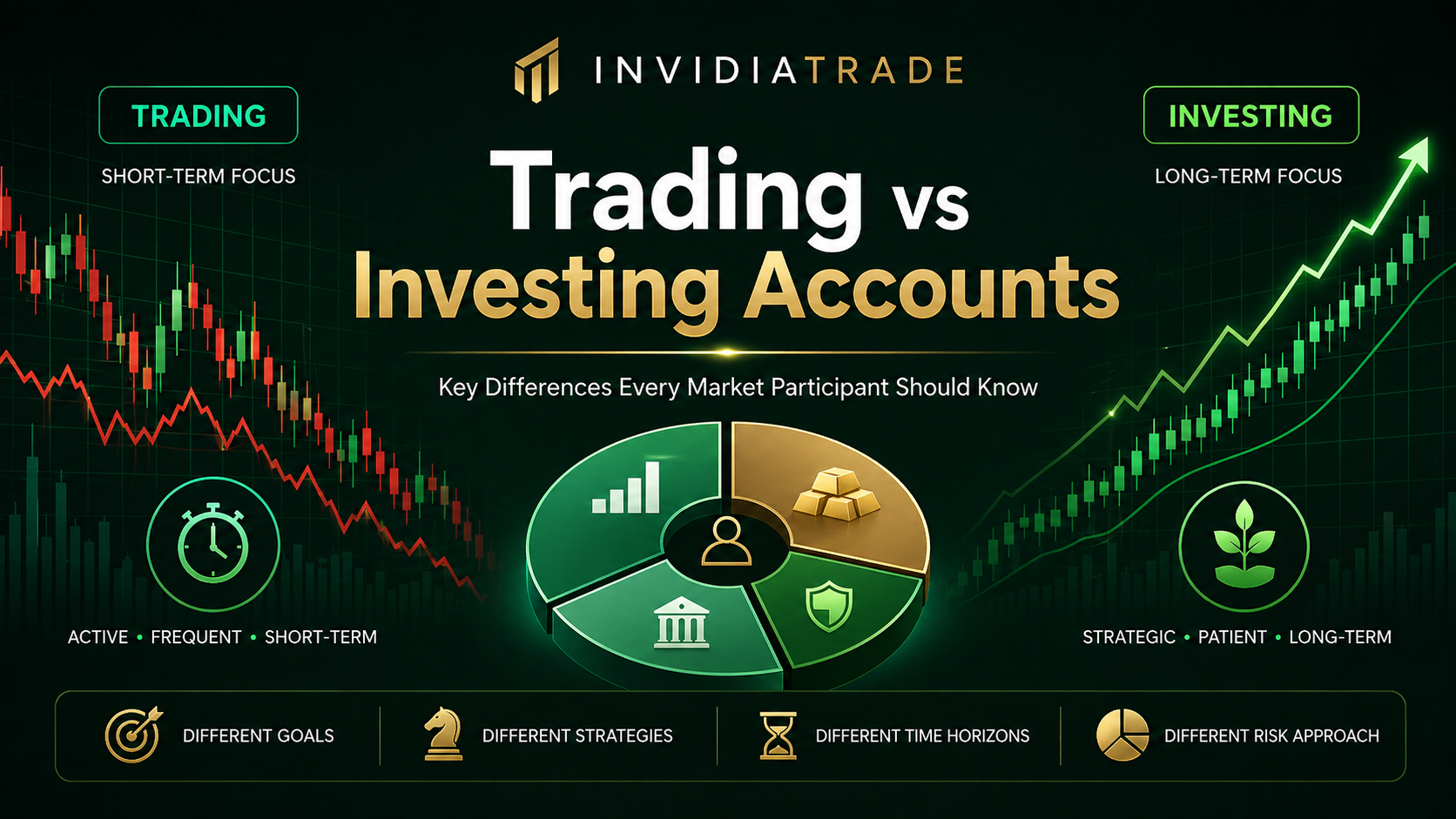
Trading vs Investing Accounts is one of the most important comparisons for anyone entering the financial markets. Many beginners think that opening an account is a simple first step. They may choose a platform quickly, deposit funds, and start buying or selling without fully understanding what type of account they are using.
That can lead to problems.
A trading account and an investing account may both connect you to financial markets, but they are designed for different purposes. They often come with different tools, risks, costs, products, and time horizons.
A trading account is generally used for active market participation. It may be used to trade forex, indices, commodities, CFDs, stocks, or other instruments over shorter periods. Traders usually focus on price movement and timing.
An investing account is generally used for long-term asset ownership or portfolio growth. It may be used to buy stocks, ETFs, funds, bonds, or other assets that are held for months, years, or longer.
The difference is not just technical. It affects how you think, how you manage risk, how often you make decisions, and how you measure success.
This article explains the key differences between trading and investing accounts. It also helps you understand which type may suit your goals, what risks to watch, and why account choice should never be rushed.

What Is a Trading Account?
A trading account is an account used to take positions in financial markets with a more active approach. The main goal is usually to benefit from price changes.
A trader may buy if they expect the price to rise. They may sell or short if they expect the price to fall, depending on the product and account type. The holding period is often shorter than with investing.
Trading accounts are commonly used for:
- Forex trading
- CFD trading
- Index trading
- Commodity trading
- Stock trading
- Short-term speculation
- Technical trading strategies
Many trading accounts offer tools for fast decisions. These may include live charts, indicators, order types, market news, watchlists, stop-loss orders, and take-profit orders.
Some trading accounts also offer leverage. Leverage allows a trader to control a larger position with a smaller amount of capital. This can increase potential returns, but it also increases risk.
A trading account is not just a place to click buy or sell. It requires a plan. Traders need to understand entries, exits, position size, risk per trade, and market conditions.
Without a plan, trading can quickly become emotional and risky.
What Is an Investing Account?
An investing account is an account used to buy and hold assets with a longer-term view. The goal is usually to build wealth over time, receive income, or preserve capital.
Investors often focus on ownership. They may buy shares in companies, units in ETFs, bonds, or other long-term assets. They may hold these assets for years.
Investing accounts are commonly used for:
- Long-term stock investing
- ETF investing
- Dividend investing
- Retirement planning
- Portfolio building
- Bond investing
- Fund investing
An investor may not need to watch the market every hour. Instead, they may review their portfolio monthly, quarterly, or annually.
Investing still involves risk. Asset prices can fall. Companies can lose value. Economic conditions can change. However, investing is usually based on longer-term expectations rather than short-term price movement.
A good investing account should make it easy to research assets, track performance, manage a portfolio, and understand costs.
Why the Difference Matters
The difference between trading and investing accounts matters because the account should match the goal.
If someone wants to build long-term wealth but opens a highly leveraged trading account, they may take more risk than planned.
If someone wants to trade actively but uses a basic investing account with limited order tools, they may not have the features needed to manage trades properly.
The wrong account can create confusion. It can also encourage poor decisions.
For example, a person may buy an asset for long-term investing but panic when it drops in the short term. Or they may open a short-term trade and then refuse to close it because they hope it will recover.
Clear account purpose helps prevent this.
Before choosing an account, every market participant should understand what they are trying to achieve.
Time Horizon
Time horizon is one of the biggest differences between trading and investing accounts.
A trading account is usually used for short-term positions. Some trades last only a few minutes. Others last hours, days, or weeks.
Common trading styles include:
- Scalping
- Day trading
- Swing trading
- Position trading
- News-based trading
The shorter the time horizon, the more important timing becomes. Traders often care about entry price, exit price, volatility, spread, and execution speed.
An investing account is usually used for longer-term positions. Investors may hold assets for years or decades. They are often less concerned with daily market movement and more focused on long-term value.
Common investing styles include:
- Buy and hold
- Dividend investing
- Index investing
- Value investing
- Growth investing
- Retirement investing
A longer time horizon can allow an investor to ignore some short-term noise. However, it does not remove risk. Long-term investments can still lose value.
The main point is simple. Trading focuses more on timing. Investing focuses more on time.
Risk Profile
Trading and investing both involve risk, but the risk profile can be different.
Trading accounts often involve higher short-term risk. This is especially true when leverage is used. Market prices can move quickly. A trader can lose money within minutes if the position moves against them.
Trading risk may come from:
- Leverage
- Volatility
- Poor execution
- Emotional decisions
- Overtrading
- Lack of stop-loss discipline
- News events
- High transaction costs
Investing accounts usually involve longer-term risk. Prices may fall over weeks, months, or years. A portfolio may underperform. A company may lose market share. Inflation may reduce purchasing power.
Investing risk may come from:
- Market downturns
- Poor asset selection
- Lack of diversification
- Long-term underperformance
- Inflation
- Interest rate changes
- Company-specific problems
Trading risk can be fast and intense. Investing risk can be slower but still serious.
Both require risk management.
Leverage and Margin
Leverage is a major reason why trading accounts and investing accounts can feel so different.
Many trading accounts allow users to trade on margin. This means the trader does not need the full value of the position upfront. Instead, they use a smaller deposit to control a larger position.
This can be useful for experienced traders who understand the risks. However, it can be dangerous for beginners.
Leverage can increase profits, but it can also increase losses. A small market move can have a large effect on the account balance.
Investing accounts may also offer margin in some cases. However, many long-term investors choose to invest without leverage. They buy assets with available funds and avoid borrowing to increase exposure.
This can make the investing approach more stable, although not risk-free.
Anyone using leverage should understand:
- Margin requirements
- Liquidation risk
- Stop-loss orders
- Position sizing
- Volatility
- Overnight fees
- Account balance risk
Leverage should never be treated casually.
Ownership of Assets
Ownership is another key difference.
With many investing accounts, you may own the asset you buy. For example, if you buy shares, you may own part of that company. If you buy an ETF, you own units in that fund.
This ownership may come with certain benefits, such as dividends or voting rights, depending on the asset and provider.
With some trading accounts, especially CFD accounts, you do not own the underlying asset. Instead, you trade a contract based on the price movement of that asset.
For example, trading a CFD on gold does not mean you own physical gold. Trading a CFD on a stock does not usually mean you own the stock.
This difference matters. It can affect:
- Dividends
- Voting rights
- Fees
- Leverage
- Tax treatment
- Risk
- Product rules
Before opening any position, make sure you know whether you are buying the asset or trading a derivative.
Costs and Fees
Costs can affect both traders and investors.
Trading accounts may include:
- Spreads
- Commissions
- Swap fees
- Overnight financing charges
- Currency conversion fees
- Inactivity fees
- Withdrawal fees
Because traders may open and close positions often, costs can add up quickly. Even small spreads can reduce performance if the trader is very active.
Investing accounts may include:
- Dealing fees
- Fund management fees
- ETF expense ratios
- Custody fees
- Platform fees
- Currency conversion fees
Investors may trade less often, but long-term fees still matter. A small annual fee can reduce returns over many years.
This is why every user should check the full fee structure before choosing an account.
Do not look only at headline pricing. Read the details. Understand when fees apply and how they may affect your strategy.
Trading Frequency
Trading accounts are usually built for frequent activity.
A trader may place several trades in one session. Some traders may place many trades in a single day. Others may only trade a few times per week.
Higher activity means more decisions. More decisions can create more chances for mistakes. It also requires more time, focus, and discipline.
Investing accounts are usually built for lower activity.
An investor may buy assets regularly and hold them. Some investors use monthly contributions. Others rebalance their portfolio from time to time.
Lower activity does not mean no effort. Investors still need to review their strategy, understand their holdings, and make adjustments when needed.
However, the pace is usually slower.
The right frequency depends on the strategy. But it must also match the person. Not everyone has the time or personality for active trading.
Market Analysis
Trading and investing often use different types of analysis.
Traders usually focus on price action and technical analysis. They may study charts, indicators, support and resistance, trendlines, candlestick patterns, and momentum.
They may also watch news events that can move markets quickly.
A trader may ask:
- Is the market trending?
- Where is support or resistance?
- Is volatility increasing?
- What is the risk-to-reward ratio?
- Where should the stop-loss go?
- When should I exit?
Investors usually focus more on fundamental analysis. They may study company earnings, revenue, debt, cash flow, valuation, management quality, dividends, and industry trends.
An investor may ask:
- Is this company financially strong?
- Is the asset fairly valued?
- Can this business grow over time?
- Does this fit my portfolio?
- What are the long-term risks?
- Is the dividend sustainable?
Both types of analysis can be useful. But they serve different purposes.
Trading analysis helps with timing. Investing analysis helps with long-term selection.
Account Tools and Features
Trading accounts often need advanced tools.
Useful trading features may include:
- Real-time charts
- Multiple order types
- Stop-loss and take-profit tools
- Fast execution
- Technical indicators
- Economic calendar
- Price alerts
- Margin monitoring
- Trade history
These tools help traders manage fast-moving markets.
Investing accounts may need different features.
Useful investing features may include:
- Portfolio tracking
- Dividend history
- Asset allocation view
- Research reports
- Fund comparison tools
- Recurring investment options
- Long-term performance charts
- Tax reports
These tools help investors manage their holdings over time.
A platform should support the way you plan to use it. A trader needs control and speed. An investor needs clarity and portfolio structure.
Mindset and Behavior
Trading and investing require different mindsets.
Trading requires quick decision-making, patience for setups, and strict discipline. A trader must accept losses as part of the process. They must avoid revenge trading and emotional risk-taking.
A trader needs rules such as:
- Maximum risk per trade
- Maximum loss per day
- Clear entry conditions
- Clear exit conditions
- Trade review process
- Limits on overtrading
Investing requires patience and long-term thinking. An investor must avoid panic selling during normal market downturns. They must also avoid chasing trends without research.
An investor needs rules such as:
- Portfolio allocation
- Diversification plan
- Review schedule
- Long-term goal
- Rebalancing approach
- Criteria for selling
Both mindsets require discipline. The difference is how that discipline is applied.
Liquidity and Access
Liquidity means how easily an asset can be bought or sold without major price impact.
Trading accounts often focus on liquid markets because active traders need to enter and exit quickly. Forex major pairs, major indices, and large stocks often have higher liquidity, although conditions can change.
Investing accounts may include both liquid and less liquid assets. Some funds, bonds, or smaller stocks may be harder to sell quickly at a desired price.
Liquidity matters because it affects execution. If liquidity is low, spreads may widen. Orders may fill at worse prices. Exiting a position may become harder.
This is especially important for traders. A fast strategy may fail if the market is not liquid enough.
Investors should also care about liquidity, especially if they may need access to funds in the future.
Regulation and Broker Choice
Account type is important, but provider choice is also important.
A market participant should review whether the broker or platform is regulated in a relevant jurisdiction. They should also understand the protections available, if any.
Important factors to check include:
- Regulation
- Account terms
- Product range
- Fee structure
- Deposit and withdrawal methods
- Customer support
- Platform stability
- Risk warnings
- Execution quality
A good-looking platform is not enough. The company behind the account matters.
Users should also read account documents carefully. This is especially important for leveraged trading accounts and derivative products.
Tax and Reporting
Trading and investing may have different tax rules. These rules depend on the country, product, account type, and personal situation.
Some tax systems treat short-term trading differently from long-term investing. Dividends, interest, capital gains, and derivative profits may also be treated differently.
Because tax rules vary widely, users should speak with a qualified tax professional in their region.
Good record keeping is important. Save account statements, transaction history, fee records, dividend records, and withdrawal details.
This can make reporting easier and reduce stress later.
Who Should Consider a Trading Account?
A trading account may suit someone who wants active involvement in the markets.
It may be suitable for someone who:
- Has time to monitor markets
- Wants to trade short-term price movement
- Understands risk management
- Can follow a trading plan
- Is comfortable with charts
- Understands leverage before using it
- Can handle losses without emotional decisions
A trading account may not be suitable for someone who wants quick money, dislikes risk, or cannot monitor positions.
Trading requires education, practice, and discipline. It should not be treated like gambling or guessing.
Who Should Consider an Investing Account?
An investing account may suit someone who wants long-term market exposure.
It may be suitable for someone who:
- Wants to build wealth over time
- Prefers long-term holdings
- Wants to buy stocks, ETFs, funds, or bonds
- Does not want to trade actively
- Values diversification
- Can handle market ups and downs
- Has clear financial goals
An investing account may not be suitable for someone who expects fast returns or reacts emotionally to every market move.
Investing is slower, but it still requires patience and research.
Can One Person Use Both?
Yes, one person can use both trading and investing accounts. However, it is important to separate them clearly.
For example, someone may use an investing account for long-term holdings and a trading account for short-term market opportunities.
This can work if each account has its own rules.
Helpful rules may include:
- Separate capital for each account
- Separate goals
- Separate risk limits
- Separate performance reviews
- No mixing of strategies
- No moving losing trades into the investing account
The last point is important. Some traders turn losing trades into “long-term investments” because they do not want to accept a loss. This can be dangerous.
A trade should remain a trade. An investment should be chosen for investment reasons.
Common Beginner Mistakes
Beginners often make avoidable mistakes when choosing between trading and investing accounts.
Common mistakes include:
- Opening an account without understanding it
- Using leverage too soon
- Trading without a plan
- Investing without research
- Ignoring fees
- Copying others blindly
- Risking too much capital
- Confusing CFDs with asset ownership
- Making emotional decisions
- Expecting guaranteed returns
These mistakes can damage confidence and capital.
The best way to reduce mistakes is to slow down. Learn first. Start small if you decide to participate. Use risk controls. Review decisions honestly.
Markets are not going anywhere. There is no need to rush into decisions you do not understand.
How to Decide Which Account Is Right for You
Choosing between trading and investing accounts starts with your goal.
Ask yourself:
- Do I want short-term trading or long-term growth?
- Do I want to own assets or trade price movement?
- How much time can I give to the markets?
- How much risk can I handle?
- Do I understand the products?
- Do I understand the fees?
- Am I prepared for losses?
- Do I have a written plan?
If you want long-term growth and less active management, an investing account may be the better fit.
If you want active market participation and understand the risks, a trading account may be more suitable.
If you are not sure, education should come before action.
Why Risk Management Matters in Both
Risk management is not only for traders. Investors need it too.
For traders, risk management may include stop-loss orders, position sizing, daily limits, and clear trade setups.
For investors, risk management may include diversification, asset allocation, regular reviews, and avoiding concentration in one asset.
The tools may differ, but the goal is the same. Protect capital and avoid decisions that can cause serious damage.
No account type guarantees success. No strategy wins all the time. Risk management helps users stay realistic and prepared.
Final Thoughts
Trading vs Investing Accounts is a simple phrase, but it covers a major decision.
A trading account is usually designed for active market participation. It often involves shorter time horizons, frequent decisions, advanced tools, and sometimes leverage.
An investing account is usually designed for long-term wealth building. It often involves asset ownership, portfolio planning, and patience.
Both account types can play a role in financial markets. But they are not the same. The best choice depends on your goals, risk tolerance, time, knowledge, and strategy.
Before opening any account, understand what it is for. Read the terms. Learn the products. Review the fees. Think carefully about risk.
A clear account choice can help you approach the markets with more confidence and fewer avoidable mistakes.
Disclaimer
This article is for educational and informational purposes only. It does not provide financial, investment, trading, tax, or legal advice. Trading and investing involve risk, and you may lose money. Leveraged products can increase losses as well as gains. Past performance does not guarantee future results. Always do your own research and consider speaking with a qualified financial professional before making financial decisions.

Define Foreign Exchange Management: Meaning, Strategies, and Currency Risk Explained
Table of Contents To define foreign exchange management, think of it as a system for dealing with the uncertainty created when the value of

Top Earning Traders: How the World’s Most Successful Traders Built Their Edge
Table of Contents The world’s top earning traders have generated fortunes from some of the most competitive markets on the planet. Some traded currencies.

AI to Buy and Sell Crypto: A Complete Guide to Automated Crypto Trading
Table of Contents Crypto markets move quickly, operate continuously, and produce enormous amounts of data. Because of this, many traders are now looking at AI

Quantitative Trading Explained: How Data, Algorithms, and Systematic Strategies Work
Table of Contents Quantitative trading is one of the most important developments in modern financial markets. Banks, hedge funds, proprietary trading firms, and independent

London Session Forex Time: Why the London Session Is the Most Important Period in Forex Trading
Table of Contents The forex market is open 24 hours a day during the trading week, allowing traders around the world to participate at

Best Robo Advisors: How Automated Investing Is Changing Wealth Management
Table of Contents Investing has become more accessible than ever before. Technology has transformed the financial industry, making it possible for individuals to build