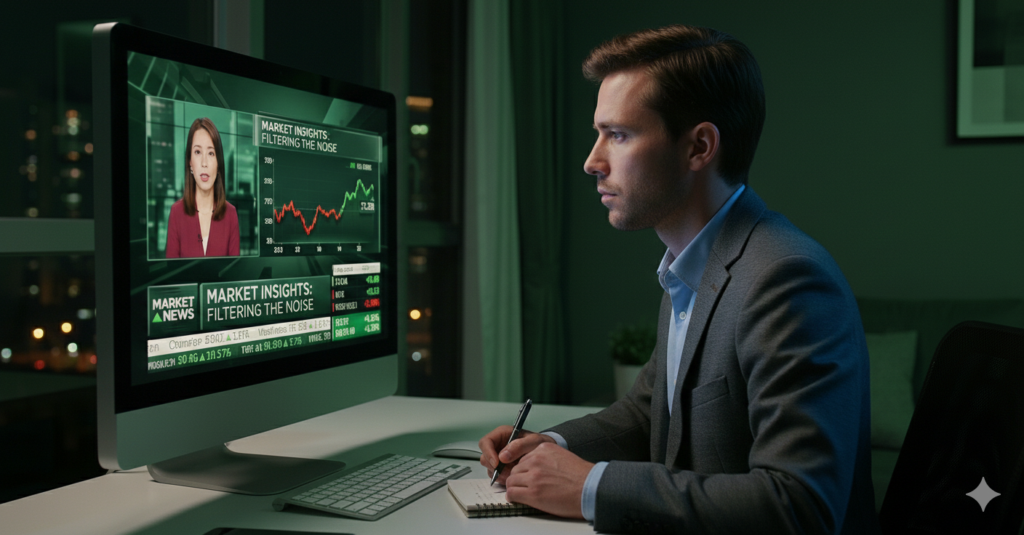
Most traders do not lose because they are uninformed. They lose because they are overloaded.
Trading news is constant. You can refresh your feed every minute and still feel behind. One source says “risk is back.” Another says “recession is coming.” A third says a single comment “changed everything.” Meanwhile, price keeps moving, and you are left guessing.
The solution is not more news. The solution is better filtering.
In this article, you will learn how to separate market noise from information that creates real opportunity. You will get a practical framework you can use daily. It works for beginners, and it scales as you gain experience. It also helps you avoid the biggest trap of all: trading based on emotion.
We will focus on trading news as a decision tool. News is not a signal by itself. News is a piece of context that can change volatility, liquidity, and expectations. When you understand that, you stop reacting and start planning.
What “trading news” really means
Trading news is any information that can influence market prices. That includes:
- Economic data releases
- Central bank decisions and speeches
- Corporate earnings and guidance
- Political events that change policy
- Geopolitical shocks and risk events
- Industry and sector updates
Not all of these matter every day. Not all of these matter to your market. Your first job is to identify what can realistically move the instruments you trade.
If you trade currencies, interest rates and macro data often matter most. If you trade indices, risk sentiment, earnings, and rates can dominate. If you trade commodities, supply, demand, and geopolitics can lead.
So filtering starts with a simple question:
“What is the market pricing right now?”
Why headlines feel powerful but usually do not help
Headlines are built for attention. Markets are built for probability.
A dramatic headline can feel like a trade. It triggers urgency. It pushes you to act fast. However, fast action without a plan is how mistakes happen.
Here is why most market headlines are low value for traders:
- They are written after price already moved.
- They simplify complex moves into one story.
- They ignore positioning and liquidity.
- They encourage “one trade” thinking instead of process thinking.
The goal is to stop treating news like a command. Treat it like input. Then decide what to do with it.
The only three reasons news moves price
Most market-moving news affects one or more of these drivers:
- Expectations
Markets move when the expected future changes. This is why “surprise versus forecast” matters so much. - Liquidity
When liquidity is thin, small orders can cause big moves. News can reduce liquidity fast. - Risk appetite
When confidence is high, traders take more risk. When fear rises, traders reduce exposure and seek safety.
If a headline does not impact expectations, liquidity, or risk appetite, it usually fades.
The 60-second filter for any piece of trading news
Before you react, use this filter. If you do this consistently, you will avoid many impulsive trades.
Question 1: Is it a scheduled event?
Scheduled events come with a time and a forecast. Examples include inflation reports and rate decisions. These are easier to plan.
Unscheduled events are surprises. They can be more dangerous because the market can gap or spread can widen.
Question 2: Is it truly high impact?
High impact means it can change expectations for policy, growth, or inflation. It does not mean it sounds dramatic.
Question 3: Is the market focused on this theme right now?
Markets rotate. Sometimes inflation is the main theme. Sometimes growth. Sometimes risk. If the news is not connected to the current theme, it may not matter much.
Question 4: Does this change the next decision point?
If it does not change what traders expect next, it is usually noise.
That final question is the most important one.
The trading news hierarchy: what matters most
When you are unsure what to follow, use a hierarchy. Start at the top.
1) Central banks and interest rate expectations
For many markets, central bank policy is the backbone. Rates influence currencies, borrowing costs, and valuations.
What matters:
- The decision
- The statement language
- The guidance about the next steps
- The tone in Q and A sessions
2) Inflation data
Inflation shapes policy expectations. Focus on surprise versus forecast and the trend.
3) Employment and wages
Jobs data often drives growth expectations and rate expectations.
4) Growth indicators
GDP, PMI surveys, retail sales, and credit conditions can shift the big picture.
5) Earnings and guidance
For equities, forward guidance can move markets more than the past quarter.
6) Geopolitical and systemic risk events
These can overpower everything. They are also unpredictable. In these moments, risk management matters more than speed.
How to build a simple daily trading news routine
You do not need to watch markets all day. You need structure.
Here is a routine that fits into real life and supports better decisions.
Step 1: Identify the day’s “risk events” (10 minutes)
Look at the highest impact calendar events and write down:
- What the event is
- When it releases
- Why it matters
- What the market expects
Do not add more. This is your map for the day.
Step 2: Decide your risk posture before the event
You have three basic options:
- Avoid trading around the event
- Reduce size and accept more volatility
- Trade it with a tested plan
Most traders should start with the first option. Avoiding bad conditions is a valid edge.
Step 3: Use scenarios instead of predictions
Do not try to “guess the number.” Build two or three scenarios.
Example:
- If inflation is higher than expected, rate expectations may rise.
- If inflation is lower, rate expectations may fall.
- If it matches forecasts, the reaction may depend on positioning.
Scenarios keep you flexible.
Step 4: After the event, measure the market’s reaction
News is not only about the data. It is about how price responds.
Ask:
- Did the first move hold or fade?
- Did volatility expand?
- Did correlated markets confirm the move?
This is how you learn what the market truly cared about.

How to trade around news without getting chopped up
Many traders get hurt by news because they trade too close to the release. They enter during unstable spreads and fast reversals.
If you want a safer approach, consider these principles:
- Let the first spike happen without you.
- Wait for a clearer structure to form.
- Trade continuation only if volatility remains controlled.
- Trade reversal only if the market shows exhaustion and confirmation.
This is not about being slow. It is about being selective.
The biggest mistakes traders make with trading news
Mistake 1: Treating every headline as equal
A rumor is not equal to a central bank decision. A minor data release is not equal to inflation.
Mistake 2: Ignoring what was expected
Markets react to surprise, not to the number. If everyone expected the result, the move can be small.
Mistake 3: Overtrading commentary
Commentary can be useful, but it is often opinion. Use it to understand narratives, not to trigger entries.
Mistake 4: Forgetting about liquidity
News can cause spreads to widen and fills to worsen. That can turn a good idea into a bad trade.
Mistake 5: Looking for certainty
News rarely gives certainty. It changes probabilities. Your job is to manage risk inside uncertainty.
Turning trading news into opportunity the right way
Trading news creates opportunity when it helps you do one of these:
- Recognize a shift in market regime
- Avoid trading during unstable conditions
- Adjust risk based on volatility
- Identify mispricing between expectations and reality
The most valuable outcome: spotting regime shifts
A regime shift is when markets change behavior.
Examples:
- A central bank changes direction
- Inflation re-accelerates after falling
- Volatility rises after a quiet period
- Correlations break, and old relationships stop working
Traders who adapt early can protect capital and find better setups.
A simple system you can use every week
Here is a weekly system that improves your filtering without adding stress.
Monday: Define the market theme
Write one sentence:
“This week, the market cares most about ______.”
Examples:
- inflation trend
- rate path expectations
- growth slowdown
- risk sentiment
Tuesday to Thursday: Track only top-tier events
Follow only events that connect to the theme. Ignore everything else unless it clearly shifts the theme.
Friday: Review surprises and reactions
List:
- The biggest surprise of the week
- The biggest move of the week
- Whether the market faded or held moves
- What that suggests about positioning
This routine builds skill fast because it trains you to focus.
How to use trading news with risk management
News should influence your risk decisions, not just your entries.
Practical ways to do this:
- Reduce position size during high volatility weeks
- Limit the number of open positions during major events
- Avoid stacking trades that are highly correlated
- Use clear maximum loss limits per day and per week
- Plan exit rules before entering, not after
If you treat risk as the priority, news becomes less scary and more useful.
What to ignore in trading news
Many traders improve just by ignoring more.
Usually safe to ignore:
- “Market is up because investors are hopeful” headlines
- Social media hype without verified sources
- Low impact data that does not affect policy expectations
- Repeated opinions that add no new information
- Small political stories with no policy change
If you are not sure, use the “next decision point” filter. If nothing changes, it is noise.
The CLEAR method for filtering trading news
Use this method when you want a quick structure.
C: Context
What is the current market theme and trend?
L: Level of impact
Is this news high impact or low impact?
E: Expectations
What was priced in before the news?
A: Actual change
What changed in probabilities after the news?
R: Risk response
Do you reduce exposure, wait, or trade a setup later?
When you consistently reach the “R,” you stop reacting emotionally. You act on purpose.
FAQ about trading news
How often should I check trading news?
Once or twice a day is enough for most traders. Focus on the calendar and major themes. Constant checking usually adds stress and leads to impulsive trades.
What trading news matters most for beginners?
Start with scheduled high-impact events: rate decisions, inflation releases, and major employment reports. These are easier to plan around than surprise headlines.
Is trading news required to be a profitable trader?
No. Many traders use technical or systematic approaches. However, knowing when high-impact news happens can help you avoid unnecessary risk.
Why does price sometimes move opposite the news?
Because the market trades expectations. If good news was already priced in, price can fall on profit-taking. Positioning and liquidity also matter.
What is the safest way to trade after news?
Many traders wait until volatility settles and price forms a clearer structure. That reduces the chance of getting caught in a spike and reversal.
Conclusion: make trading news work for you
Trading news can feel like chaos, but it does not have to.
When you focus on expectations, liquidity, and risk appetite, you naturally filter out most noise. When you follow the hierarchy, you know what deserves attention. When you use a routine, you stay informed without being overwhelmed.
The result is simple. You trade less emotionally. You plan better. You protect your capital. And you spot real opportunity when it shows up.
Disclaimer (InvidiaTrade)
This content is provided for educational and informational purposes only and should not be construed as investment advice, financial advice, trading advice, or a solicitation to buy or sell any financial instruments. Trading and investing involve risk, including the potential loss of all invested capital. Past performance does not guarantee future results. Any examples are illustrative and not a promise of returns. You are solely responsible for your trading decisions, and you should evaluate your objectives and risk tolerance. Consider seeking independent advice from a qualified professional if you are unsure.

CFDs Trading Explained: How Contracts for Difference Work, Risks Included
Many people enter the markets looking for clarity. They hear about forex, stocks, indices, and commodities, but they are still unsure how trading actually works.

Essential Trading Tools Every Serious Trader Uses (And How to Choose the Right Ones)
A practical overview of how a forex demo account works and what traders should know before getting started.

Trading News That Actually Matters: How to Filter Market Noise From Real Opportunity
START A DEMO ACCOUNT WITH INVIDIATRADE HERE Most traders do not lose because they are uninformed. They lose because they are overloaded. Trading news is

Trading Analysis Explained: How Professionals Read Markets Before Placing a Trade
START A DEMO ACCOUNT WITH INVIDIATRADE HERE Disclaimer (InvidiaTrade): This article is for educational purposes only and does not provide financial, investment, or trading advice.

What Makes a Best Trading Platform?
START A DEMO ACCOUNT WITH INVIDIATRADE HERE When people search for the best trading platform, they often expect a single answer. In reality, “best” depends

Day Trading: What It Is, How It Works, and the Risks You Must Know
Day trading gets a lot of attention because it looks exciting. Trades happen quickly, charts move fast, and results show up in minutes instead of