
Table of Contents
Introduction
Commodity prices today are more than numbers on a screen.
They can show pressure in the global economy. They can reflect supply shortages, stronger demand, weather problems, inflation concerns, currency movement, and investor fear.
For traders, this information is useful.
Even if a trader does not trade commodities directly, commodity markets can still affect forex pairs, indices, stocks, and overall market sentiment.
Oil can influence inflation and energy costs. Gold can react to risk and interest rates. Copper can reflect industrial demand. Wheat, corn, and other agricultural products can show pressure in food supply chains.
This is why many traders check commodity prices today before making a decision.
They want to understand the market environment.
They want to know whether risk is rising or falling.
They want to see whether major commodities are confirming or contradicting other market signals.
In this article, we will explain how commodity prices work, what moves them, which commodities traders watch most, and how to use this information in a practical trading routine.

What Does Commodity Prices Today Mean?
When people search for commodity prices today, they usually want current information about major raw material markets.
These markets include energy, metals, agriculture, and livestock.
The most followed commodities include:
- Crude oil
- Natural gas
- Gold
- Silver
- Copper
- Wheat
- Corn
- Soybeans
- Coffee
- Cocoa
- Sugar
- Cotton
These commodities are traded in global markets. Their prices can change throughout the trading day.
Some traders look at spot prices. Others follow futures contracts. Some use commodity indexes to understand the broader trend.
The important point is simple.
Commodity prices show what buyers and sellers are willing to pay for important raw materials.
When prices move, they often tell a story.
Why Commodity Prices Matter for Traders
Commodity markets can affect many other markets.
This is because commodities are connected to real-world costs.
Oil affects fuel, transport, shipping, and production.
Food commodities affect grocery prices and inflation.
Metals affect construction, manufacturing, electronics, and industrial activity.
Gold affects safe-haven demand and investor confidence.
When commodity prices move strongly, traders often look for the reason behind the move.
For example:
- Rising oil can point to supply concerns or stronger demand.
- Rising gold can suggest fear, uncertainty, or inflation concerns.
- Rising copper can show stronger industrial expectations.
- Falling agricultural prices can show better supply conditions.
- Falling energy prices can reduce inflation pressure.
Commodity prices today can help traders understand the bigger picture before entering a trade.
The Main Commodity Groups
Commodities are usually divided into several groups.
Each group has different drivers.
Energy Commodities
Energy commodities include crude oil, natural gas, gasoline, and heating oil.
Crude oil is one of the most important commodities in the world. It affects transportation, shipping, production costs, and inflation.
Natural gas is also important. It is used for heating, electricity, and industrial production.
Energy prices can move because of:
- Production levels
- Inventory reports
- Global demand
- Weather conditions
- Supply disruptions
- OPEC decisions
- Geopolitical events
- Transportation routes
Energy commodities can be volatile. Traders should be careful when major news is expected.
Precious Metals
Precious metals include gold, silver, platinum, and palladium.
Gold is the most watched precious metal.
Many traders watch gold because it can react to:
- U.S. dollar strength
- Interest rates
- Inflation expectations
- Central bank policy
- Geopolitical risk
- Investor fear
- Market uncertainty
Silver can act partly like a precious metal and partly like an industrial metal. This makes it more complex.
Precious metals can be useful for understanding market sentiment.
Industrial Metals
Industrial metals include copper, aluminum, zinc, nickel, and iron ore.
Copper is one of the most followed industrial metals. It is used in construction, electronics, manufacturing, and energy infrastructure.
When copper rises, some traders see it as a sign of stronger industrial demand.
When copper falls, traders may see weaker growth expectations.
Industrial metals can be affected by:
- Manufacturing activity
- Construction demand
- China’s economy
- Infrastructure spending
- Supply disruptions
- Mining output
- Global trade
These markets are important for traders who want to understand economic momentum.
Agricultural Commodities
Agricultural commodities include wheat, corn, soybeans, coffee, sugar, cocoa, and cotton.
These prices can change because of:
- Weather
- Crop yields
- Planting conditions
- Harvest reports
- Fertilizer prices
- Export restrictions
- Global food demand
- Shipping costs
Agricultural markets can move sharply when supply concerns appear.
Weather is especially important. A drought, flood, or poor harvest can affect prices quickly.
What Moves Commodity Prices Today?
Commodity prices move because markets respond to new information.
Some moves are based on real supply and demand. Others are based on expectations.
Here are the main factors traders should watch.
Supply Conditions
Supply is one of the biggest drivers of commodity prices.
If supply falls, prices may rise.
If supply increases, prices may fall.
For example, if oil production drops, buyers may compete for less available supply. That can push prices higher.
If crop output is stronger than expected, agricultural prices may weaken.
Supply can be affected by production decisions, weather, transport issues, conflict, regulations, and inventory levels.
Demand Conditions
Demand is just as important.
If demand rises, prices may increase.
If demand falls, prices may decrease.
Demand can change because of economic growth, consumer behavior, industrial activity, seasonal needs, and global trade.
For example, strong manufacturing activity may support copper. Cold weather may increase natural gas demand. Strong travel demand may support oil.
Demand is not always easy to measure in real time. That is why traders often use price action, reports, and market expectations.
The U.S. Dollar
Many commodities are priced in U.S. dollars.
This creates an important relationship.
When the dollar rises, commodities can become more expensive for buyers using other currencies. This can reduce demand and pressure prices.
When the dollar falls, commodities can become cheaper for global buyers. This can support demand and prices.
This relationship is not perfect, but it matters.
Gold, oil, and copper can all react to dollar strength or weakness.
Interest Rates
Interest rates can affect commodities in different ways.
Higher interest rates can make bonds and cash more attractive. This can reduce demand for assets like gold.
Higher rates can also slow economic activity, which may reduce demand for industrial commodities.
Lower interest rates can support risk appetite and growth expectations.
Traders should watch central bank expectations because they can influence commodities, currencies, and indices at the same time.
Inflation Expectations
Commodities and inflation are closely connected.
Energy and food are major parts of inflation.
When commodity prices rise, inflation pressure can increase.
When commodity prices fall, inflation pressure can ease.
This is why traders watch oil, food, and metal prices. These markets can shape expectations about central bank policy.
Inflation can also support demand for certain commodities, especially when investors look for protection against falling purchasing power.
Geopolitical Risk
Geopolitical events can create sudden commodity moves.
Oil is very sensitive to this. Any risk to production, shipping routes, or supply chains can move energy prices quickly.
Gold can also react when investors become nervous.
Agricultural markets can move if trade routes, farming regions, or exports are affected.
Traders should be careful during high-risk news periods. Price can move sharply in both directions.
Weather and Seasonality
Weather can strongly affect commodities.
Natural gas reacts to heating and cooling demand.
Agricultural commodities react to planting, growing, and harvest conditions.
Seasonality can also matter. Some commodities tend to have stronger demand during certain parts of the year.
Traders should know whether a commodity is entering a seasonal period that may affect price behavior.
How to Read Commodity Prices Today
A price quote alone is not enough.
Traders should read commodity prices in context.
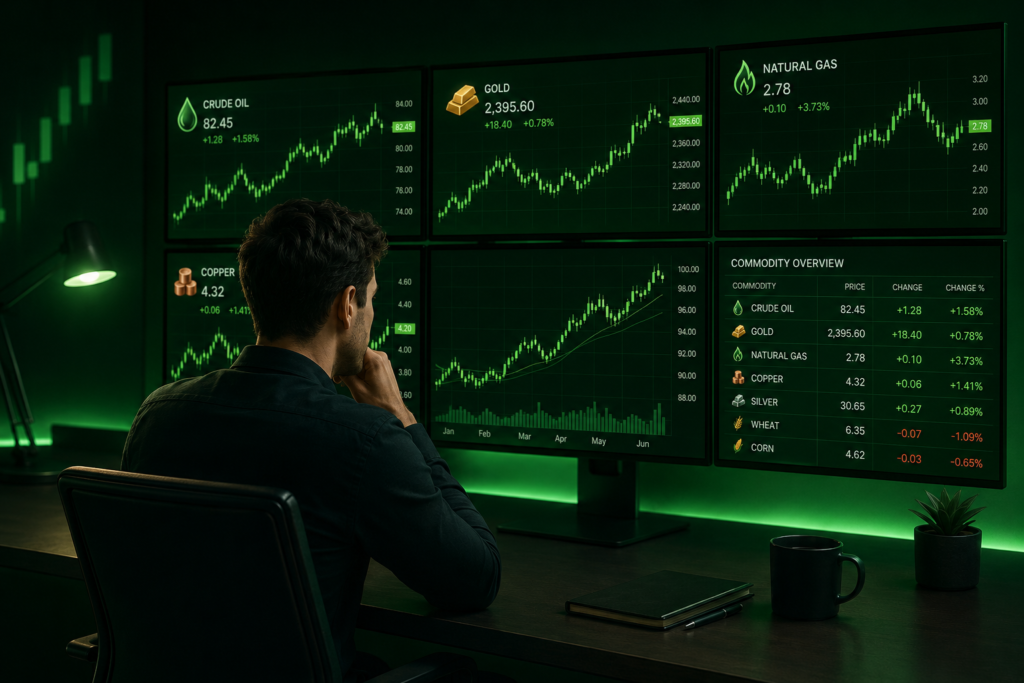
A good process includes trend, levels, volatility, and market drivers.
Step 1: Identify the Trend
The first question is simple.
Is the commodity moving up, down, or sideways?
An uptrend means price is making higher highs and higher lows.
A downtrend means price is making lower highs and lower lows.
A sideways market means price is moving between support and resistance.
Trend gives direction.
It helps traders avoid fighting the market.
Step 2: Mark Support and Resistance
Support is where buyers may enter.
Resistance is where sellers may enter.
These zones are important because price often reacts around them.
Traders should look for areas where price has bounced, rejected, broken out, or consolidated before.
Support and resistance do not guarantee anything. But they help traders plan entries, exits, and risk.
Step 3: Check Volatility
Commodity markets can move fast.
High volatility can create opportunity, but it can also increase risk.
Before entering a trade, traders should ask:
- Is price moving normally?
- Is the spread wider than usual?
- Is there major news?
- Is the market reacting emotionally?
- Is the potential stop loss too wide?
If volatility is too high, waiting may be the better decision.
Step 4: Understand the News
News can explain why a commodity is moving.
But traders should not follow headlines blindly.
Sometimes the market has already priced in the news. Sometimes the first reaction is wrong. Sometimes a headline creates a spike that quickly fades.
News should be used with price action.
The best question is not only, “What happened?”
The better question is, “How is the market reacting?”
Step 5: Compare Related Markets
Commodities often connect with other assets.
For example:
- Oil can affect the Canadian dollar.
- Gold can affect risk sentiment.
- Copper can reflect industrial demand.
- The U.S. dollar can affect many commodities.
- Bond yields can affect gold.
When related markets confirm each other, the signal may be stronger.
When they disagree, traders should be more careful.
Commodity Prices and Forex
Commodity prices can be useful for forex traders.
Some currencies are connected to commodity exports.
These currencies are often called commodity currencies.
Examples include:
- Canadian dollar
- Australian dollar
- New Zealand dollar
The Canadian dollar can react to oil prices because Canada is a major energy exporter.
The Australian dollar can react to metals, global growth, and China-related demand.
The New Zealand dollar can react to agricultural exports and risk sentiment.
These relationships are not perfect. But they can help traders understand why certain currency pairs are moving.
For example, if oil is rising and the Canadian dollar is strengthening, the move may have a logical connection.
If oil is rising but the Canadian dollar is weak, traders may look for another reason.
Gold as a Market Signal
Gold is one of the most watched commodities.
It can act as a safe-haven asset, an inflation hedge, and a dollar-sensitive market.
Gold often reacts to:
- U.S. dollar movement
- Interest rates
- Bond yields
- Inflation data
- Geopolitical risk
- Central bank policy
- Investor sentiment
When gold rises strongly, traders often ask whether fear is increasing.
When gold falls, traders may ask whether risk appetite is improving or whether the dollar is stronger.
Gold is not always easy to read. But it can provide useful context.
Oil as a Market Signal
Oil is important because it affects the global economy.
Higher oil prices can increase fuel and transport costs. This can add inflation pressure.
Lower oil prices can reduce inflation pressure, but they can also signal weaker demand.
Oil traders often watch:
- Inventory reports
- OPEC decisions
- Global demand forecasts
- Shipping routes
- Production levels
- Geopolitical risk
- Refinery activity
Oil can also influence energy stocks, inflation expectations, and currencies.
Copper as a Market Signal
Copper is often called an industrial barometer.
This is because copper is used in many parts of the economy.
When copper demand is strong, it can suggest stronger industrial activity.
When copper weakens, it can suggest lower demand expectations.
Copper is often watched by traders who want to understand global growth.
It is especially connected to construction, manufacturing, and infrastructure.
Agricultural Commodities as a Market Signal
Agricultural commodities can show pressure in food markets.
Wheat, corn, soybeans, coffee, cocoa, and sugar can all react to supply and demand changes.
Weather is a major factor.
So are export rules, fertilizer costs, and shipping conditions.
Agricultural price changes can also affect inflation, especially in countries where food takes up a large share of consumer spending.
A Practical Daily Routine for Traders
Traders do not need to spend hours studying every commodity.
A simple routine can help.
Morning Market Check
Start with the major commodities.
Check:
- Oil
- Gold
- Copper
- Natural gas
- Major grains
Look at whether they are moving up, down, or sideways.
Check the U.S. Dollar
Because many commodities are priced in dollars, the dollar matters.
If the dollar is strong, some commodities may face pressure.
If the dollar is weak, some commodities may find support.
Look at Major News
Check whether there are major events affecting commodities.
This can include:
- Energy news
- Central bank updates
- Inflation data
- Weather reports
- Supply disruptions
- Geopolitical headlines
- Inventory reports
Mark Key Levels
Before trading, mark important support and resistance zones.
This gives structure to the trade idea.
Wait for Confirmation
Do not enter only because a price is moving.
Wait for a setup that matches your plan.
This may include:
- Breakout confirmation
- Retest of a level
- Rejection from resistance
- Bounce from support
- Trend continuation
- Pullback into value
Manage Risk
Risk management is the most important part.
No trader can control the market.
But every trader can control position size, stop placement, and exposure.
Common Mistakes to Avoid
Commodity trading can be risky when traders act emotionally.
Here are common mistakes.
Chasing Price
A large move can make traders feel like they are missing out.
But entering after a sharp move can be dangerous.
Price often pulls back.
It is better to wait for structure.
Ignoring the Bigger Trend
A short-term move may look strong, but the higher time frame may show a different story.
Always check the bigger picture.
Trading Every Headline
Not every headline deserves a trade.
Some headlines create noise. Others create real market shifts.
The price reaction matters more than the headline itself.
Using Too Much Leverage
Commodities can move fast.
Too much leverage can turn a normal move into a major loss.
Risk should always come first.
Forgetting About Correlations
Commodity relationships can change.
Oil does not always move with the Canadian dollar. Gold does not always move opposite the dollar. Copper does not always predict growth perfectly.
Use correlations as context, not as a guarantee.
How InvidiaTrade Traders Can Use Commodity Prices Today
InvidiaTrade traders can use commodity prices as part of a broader market analysis process.
The goal is not to predict every move.
The goal is to understand context.
Commodity prices today can help traders answer important questions:
- Is the market reacting to inflation?
- Is risk sentiment improving or weakening?
- Is the dollar supporting or pressuring commodities?
- Are energy prices affecting currencies?
- Is gold showing demand for safety?
- Is copper confirming growth expectations?
- Are agricultural prices adding inflation pressure?
This information can support better decision-making.
It can also help traders avoid taking trades without context.
Commodity Prices Today and Risk Management
Risk management should always come before profit potential.
Commodity markets can be unpredictable.
Even strong analysis can be wrong.
That is why traders should use clear risk rules.
Good risk management includes:
- Using sensible position size
- Avoiding over-leverage
- Planning the stop before entry
- Knowing the invalidation point
- Avoiding emotional revenge trades
- Reducing risk during major news
- Reviewing trades after closing them
A trader who manages risk well can survive losing trades.
A trader who ignores risk can lose even with good analysis.
Final Thoughts
Commodity prices today can give traders valuable market insight.
They show how raw material markets are reacting to supply, demand, inflation, interest rates, currency movement, and global risk.
Oil can show energy pressure.
Gold can show safety demand.
Copper can show industrial expectations.
Agricultural commodities can show food supply conditions.
But no single commodity tells the full story.
Traders should combine commodity prices with trend analysis, support and resistance, volatility, market news, and risk management.
The goal is not to react to every move.
The goal is to build a clearer view of the market before entering a trade.
For InvidiaTrade traders, commodity prices can be a useful part of daily analysis. They can help traders understand the bigger picture, avoid emotional decisions, and trade with more structure.
Disclaimer
This article is for educational and informational purposes only. It does not provide financial advice, investment advice, trading advice, or a recommendation to buy or sell any financial instrument. Trading commodities, forex, CFDs, and other leveraged products involves risk and may not be suitable for all traders. Market prices can move quickly and losses can exceed expectations. Past performance does not guarantee future results. Always do your own research and consider speaking with a licensed financial professional before making trading decisions.
Define Foreign Exchange Management: Meaning, Strategies, and Currency Risk Explained
Table of Contents To define foreign exchange management, think of it as a system for dealing with the uncertainty created when the value of

Top Earning Traders: How the World’s Most Successful Traders Built Their Edge
Table of Contents The world’s top earning traders have generated fortunes from some of the most competitive markets on the planet. Some traded currencies.

AI to Buy and Sell Crypto: A Complete Guide to Automated Crypto Trading
Table of Contents Crypto markets move quickly, operate continuously, and produce enormous amounts of data. Because of this, many traders are now looking at AI
Quantitative Trading Explained: How Data, Algorithms, and Systematic Strategies Work
Table of Contents Quantitative trading is one of the most important developments in modern financial markets. Banks, hedge funds, proprietary trading firms, and independent
London Session Forex Time: Why the London Session Is the Most Important Period in Forex Trading
Table of Contents The forex market is open 24 hours a day during the trading week, allowing traders around the world to participate at

Best Robo Advisors: How Automated Investing Is Changing Wealth Management
Table of Contents Investing has become more accessible than ever before. Technology has transformed the financial industry, making it possible for individuals to build